
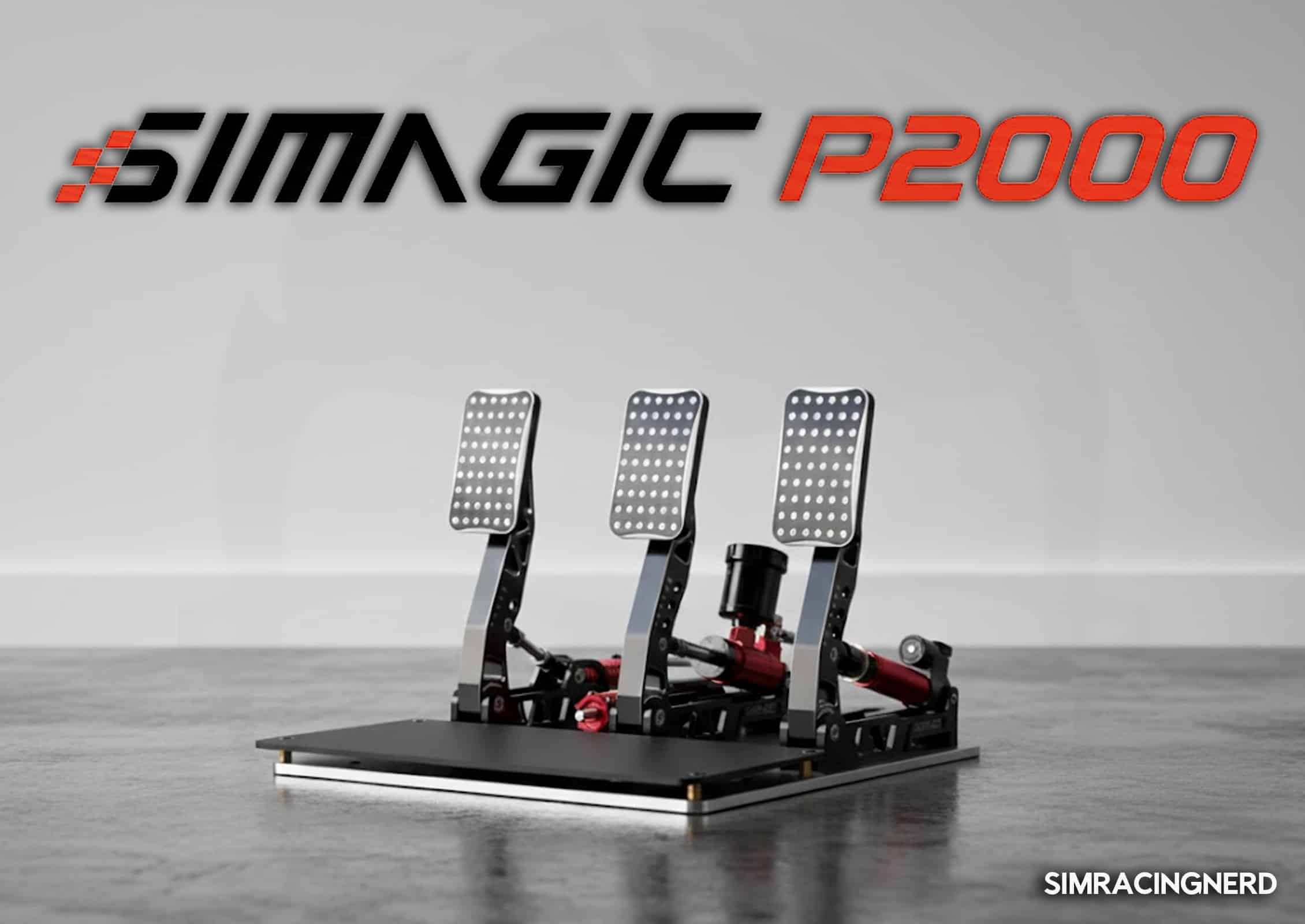

The Simagic P2000 in a nutshell
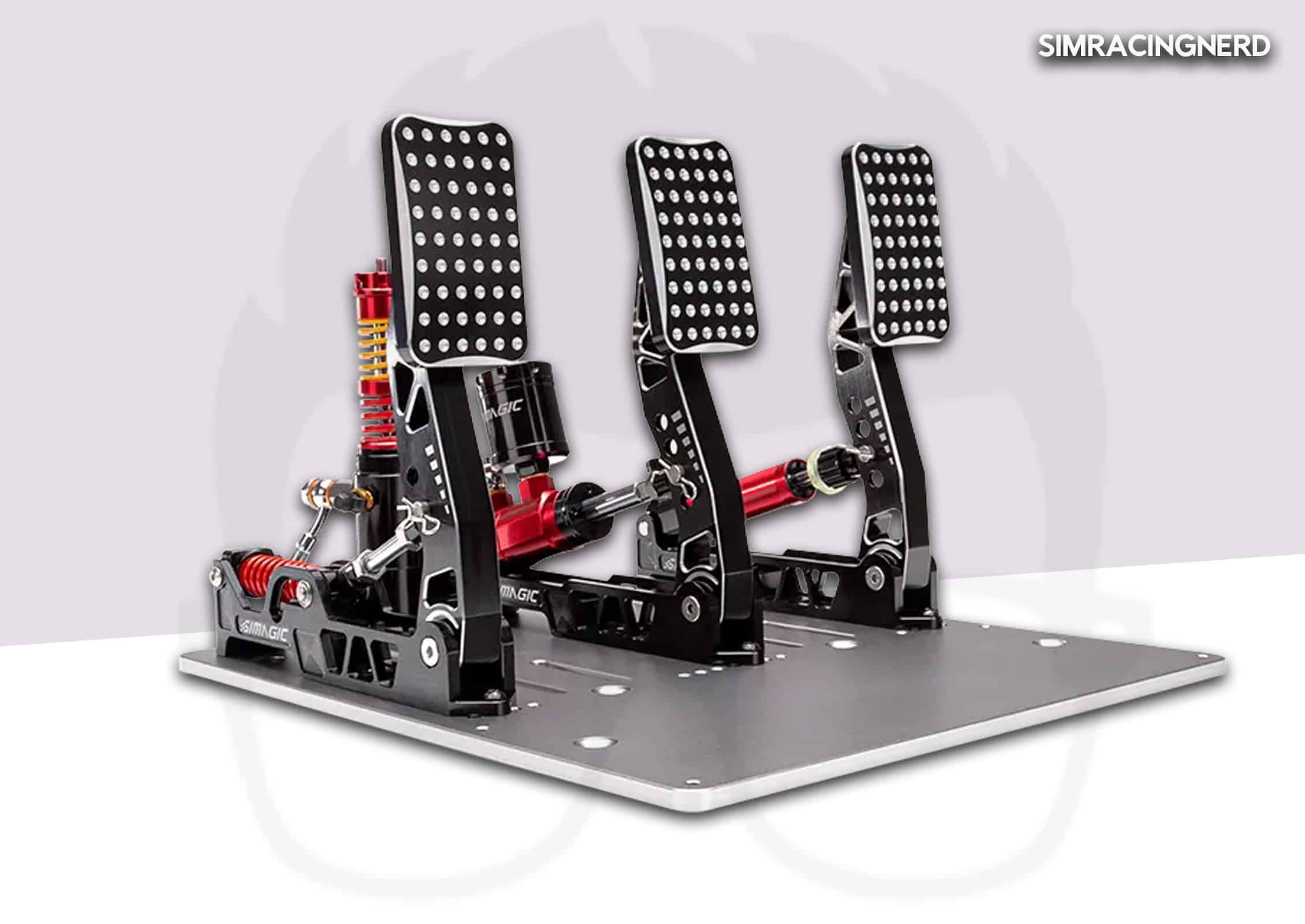
Advantages & Disadvantages
✅ Available in several versions depending on configuration and need
✅ Crankset with Load Cell and hydraulic systems
✅ Aluminum structure
❌ Exposed electronics and wiring
Like Moza Racing, Simagic is a rather young player in the sim-racing industry.
The manufacturer is powered by a team of engineers with a passion for sim-racing and motor racing, backed up by real racing drivers. Simagic’s catalog is not as extensive as Fanatec‘s, but the brand offers a fairly comprehensive range.
The range includes Direct Drive bases, steering wheels, pedalboards and other sim-racing equipment. Simagic’s range of cranksets includes the P2000, representing the manufacturer’s top-of-the-range offering. It’s a full Load Cell device with a hydraulic sensor for the brake pedal. Today, we’ve got it on our setup for a full test.
Main features and technical specifications of the crankset
- Entire aluminium structure, with large support plate
- Load Cell available in 100 and 200 kg versions
- Available in 2 or 3 pedal configuration, with Load Cell and hydraulic system
- Configurable visual elements, including accelerator pedal plate
- Adjustable pedals in several planes, also detachable for installation without support plate
- PC-only compatible with the entire Simagic ecosystem
P2000 design
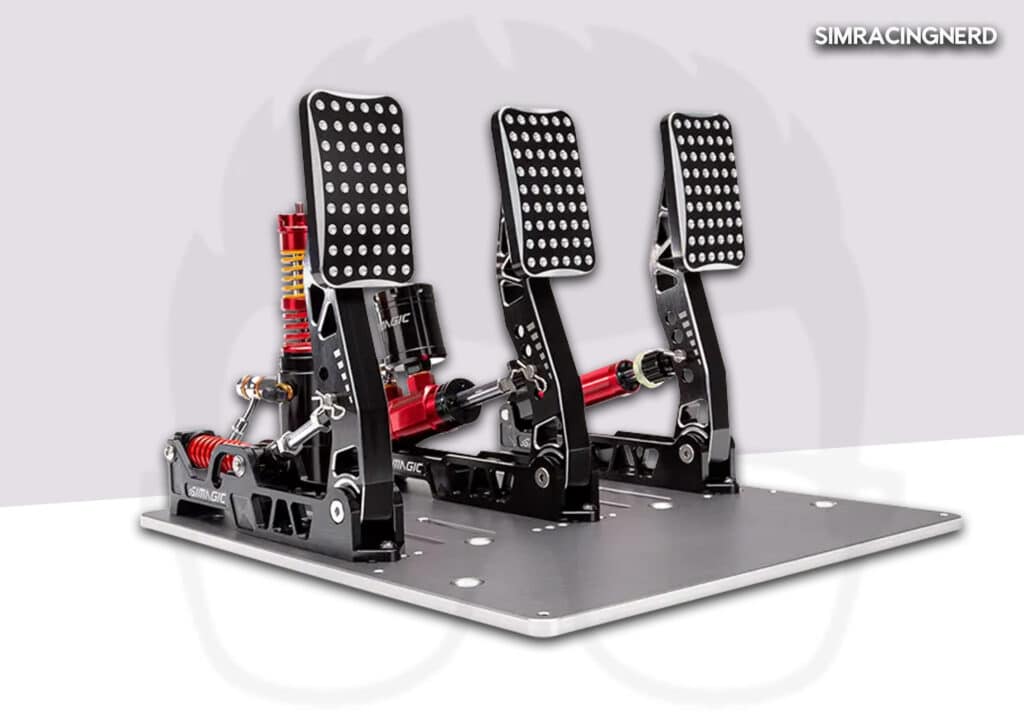
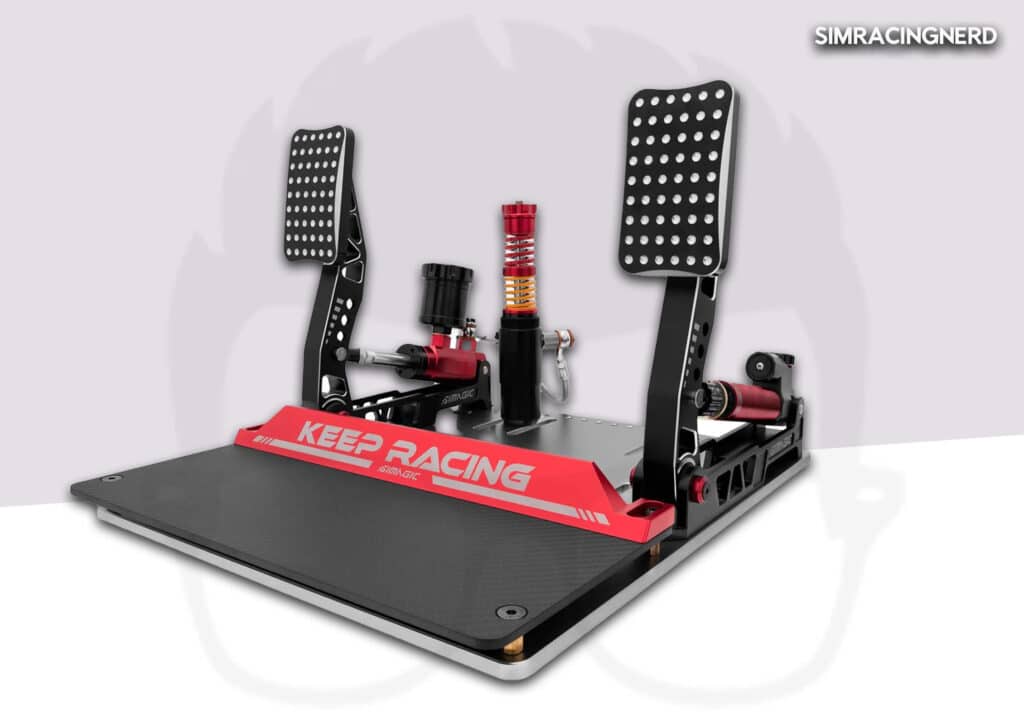
Most of Simagic’s peripherals are sober, but with a touch of racing in their design, and the P2000 is no exception. The result is a visually minimalist device, with a few flashy elements, notably the resistance system on the back of the pedals.
Speaking of which, the pedals are mostly painted black, with a few silver elements. As for the rest, it’s at the rear that the story changes: red, black and gold are used for the springs, cylinders and the rest of the resistance system components.
This color combination gives the P2000 a unique look. It’s beautiful overall, and should go very well with any sim-racing setup.
Customized assembly
Depending on the version of the P2000, you can choose between 2 and 3 pedals. Each pedal is independent, and the whole package comes with a support plate that acts as a host for them. Of course, you can opt to mount them on the plate itself, or directly on the cockpit if you feel like it.
Assembly of the P2000 is relatively straightforward. The brake pedal has 7 different positions, spaced 15 mm apart. The gas pedal and clutch pedals have 5 positions, with 11 mm spacing between them.
You’ll find it easy to find your bearings on the P2000, as this crankset is inspired by racing, and is therefore highly configurable.
Manufacturing and finishing
Made almost entirely of aluminum, the P2000 screams premium from the rooftops. You can see it, and feel it on your arms too. The support plate is heavy and thick, to counter the force of the braking system, which can weigh between 100 and 200 kg.
As for the finish, everything is cut using CNC machines, so precision is the order of the day. I didn’t notice any burrs on the metal parts, poorly positioned holes, or anything that stood out from perfection. This is a premium product, Simagic knows it, and the brand has made sure that all virtual pilots know it too.
However, the device’s control box leaves something to be desired. It’s not the choice of materials or a manufacturing defect, no, but rather a mounting problem: the brand hasn’t found anything other than double-sided tape to attach its P2000 control box. And let me tell you, it doesn’t look good at all on its top-of-the-range crankset.
Bottom bracket settings
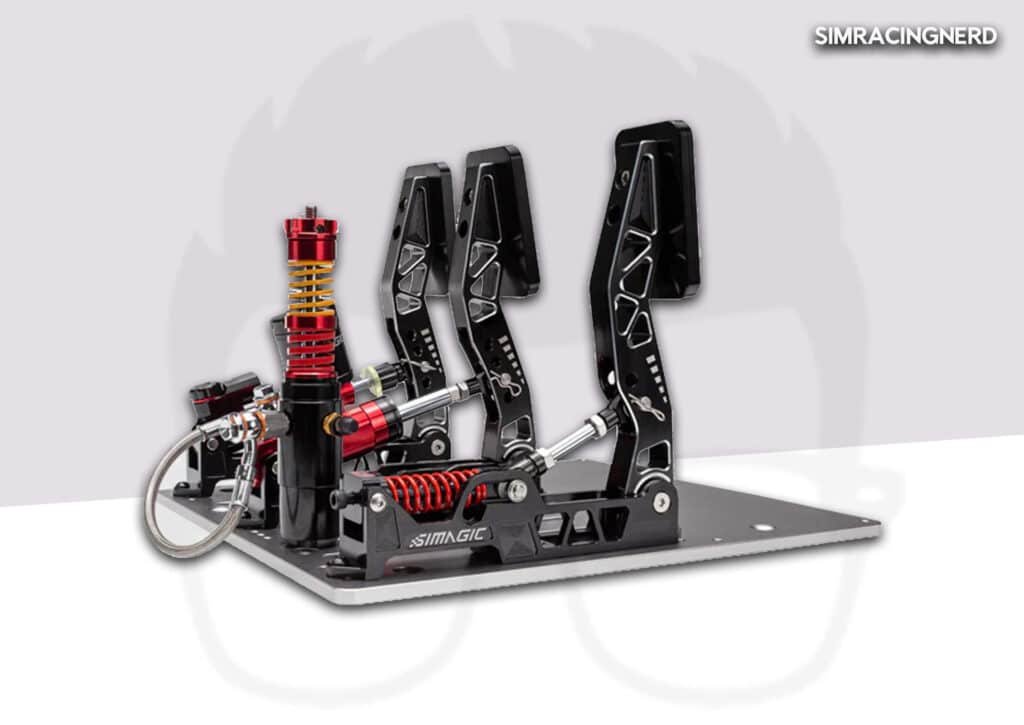
For adjustments, as mentioned above, each pedal can be positioned in different lateral positions. The brake has the most options, and that’s to be expected as it’s the centerpiece of the whole package.
Of course, you can adjust the stroke of each pedal, pedal inclination, pedal plate angle, resistance system hardness, end stop, and so on. It’s more than complete, and above all adapted to the needs of demanding riders.
Let’s not forget that the P2000 represents the very best of Simagic, and the brand has pulled out all the stops to meet riders’ expectations. And in addition to the springs already installed on the pedals, the brand supplies other springs with the P2000 so you can find the right compromise to suit your needs and preferences.
Sensations during play
Simagic offered us the combination of a Load Cell and hydraulic brake pedal, plus two other pedals that are also Load Cell. On a sim-racing setup, this makes the P2000 an excellent pedalboard to use, especially if you pair it with a high-end rig.
You can choose between a brake force of 100 or 200 kg, with the big advantage of the hydraulic system based on feedback fidelity. The middle pedal, if you opt for a P2000 with 3 pedals of course, is exceptionally talkative, reporting absolutely everything the wheels do when the brake is applied to it.
What’s more, the stroke is adjustable, which should appeal to riders who like the brake to be long, and not like on some Load Cells where you quickly reach the stop, and therefore virtually a concrete wall.
As for the other two pedals, the throttle is very soft if you want it to be, despite the presence of a damper resistance system. Several settings are available via a thumbwheel, and it’s easy enough to find the right resistance.
As far as the clutch is concerned, the pedal is rather unusual in its operation: you have a spring for resistance, and a kind of notch that acts as a dead stop to stop the pedal. Adjustment of the pedal must involve both hardware (spring) and software (deadzone) to find the right balance.
p2000 compatibility
Simagic’s P2000 is only compatible with PCs running Windows. This was to be expected, as the manufacturer’s entire range can only be used on Microsoft’s platform.
Speaking of Simagic’s other products, the P2000 is supported by all the brand’s peripherals, and integrates natively with its software too.
Value for money
The P2000 is available in several versions, with 2 or 3 pedals. Prices differ slightly, but expect to pay between €730 and €830 for the most complete version.
Compared to a ClubSport Pedals V3, the P2000 is expensive. But don’t forget that Simagic’s pedalboard is in a different segment from Fanatec’s, and I think the P2000’s value for money is pretty good, especially with the settings available and the sensations this pedalboard provides.
My verdict on Simagic’s P2000 pedalboard
Simagic is aiming to appeal to a specific audience with its P2000, and it’s that of experienced sim-racing drivers. It’s a device that adapts perfectly to your driving preferences, whatever the discipline.
The combination of a Load Cell and hydraulic system gives the P2000 a certain advantage over cranksets that are Load Cell only. It’s a superb sim-racing peripheral that’s more than feasible if you have the setup to go with it. If you’ve got the money and the equipment to back up the P2000, then look no further than this crankset.

0 Comments