

Simucube is one of the world’s best-known sim-racing brands, especially when it comes to an elitist audience.
The Finnish manufacturer is very clear in what it aims to do: offer the best sim-racing peripherals in the world, both the most realistic, and also offering a very high level of immersion.
The brand’s catalog covers a bit of everything in sim-racing, with steering wheels that are typically Formula, GT and endurance, but also touring. For the rest of the equipment, we have accessories such as QR and hub, an active pedalboard which is unique in its kind thanks to a Direct Drive motor to simulate braking on three pedals. And of course, Simucube also offers DD chainstays ranging from 15 to 35 nm of torque. Where other brands stop when it comes to the power of their chainstays, Simucube considers them “entry-level”.
The brand recently launched a brand-new range of Direct Drive bases to replace the Simucube 2: the Simucube 3, available in Sport, Pro and Ultimate variants. The most radical change from the previous generation is the design. In what follows, we take a closer look at the basics.
The Simucube 3 Sport
Design and features
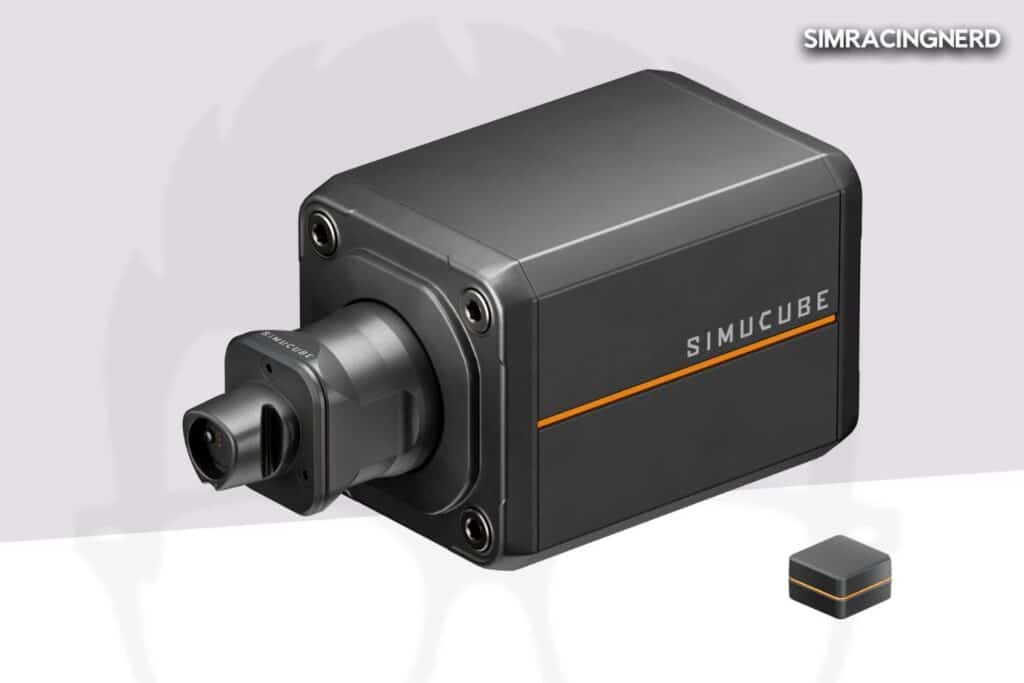
The big change between the Simucube 2 Sport and the 3 is in the design. The new Simucube bases are more beautiful, more sober and more attractive. The shape becomes rectangular, with 45°C edges. The color of the base is now dark gray, and on the side there’s an orange line with the Simucube logo in white.
Technical specifications are based on a new SPM electric motor that can develop up to 25 nm of torque. On the Simucube 3 Sport, this motor is limited to 15 nm peak, with a 23-bit encoder and power consumption of around 280 watts.
On the front of the Simucube 3 Sport is a brand-new Quick Release, which is the same on all other DD base variants. This QR resembles the one used by Fanatec, with a triangular shape and rounded corners. On the sides of the QR, it’s just like Fanatec‘s, with notches to accommodate the device’s security mechanism. I think it’s a much better design than the old Simucube QR, because now it’s quicker to swap wheels.
Materials and build quality
The base uses an all-metal housing for two reasons: to offer a premium product and to cool the motor and on-board electronics. In terms of quality, the Simucube 3 Sport is very well served, with a premium base worthy of the brand’s other products.
Value for money
Needless to say, Simucube products are expensive, and the 3 Sport is no exception. The 3 Sport’s price isn’t all that high compared to the 2 Sport it will replace, but there’s a slight catch this time: you need a hub called Simucube Link to take full advantage of the new base.
So, if you opt for the peripheral with the hub, you can get this base for around €1,330. And if you take the base without the hub, the bill drops to around €1240.
The Simucube 3 Pro
Design and features
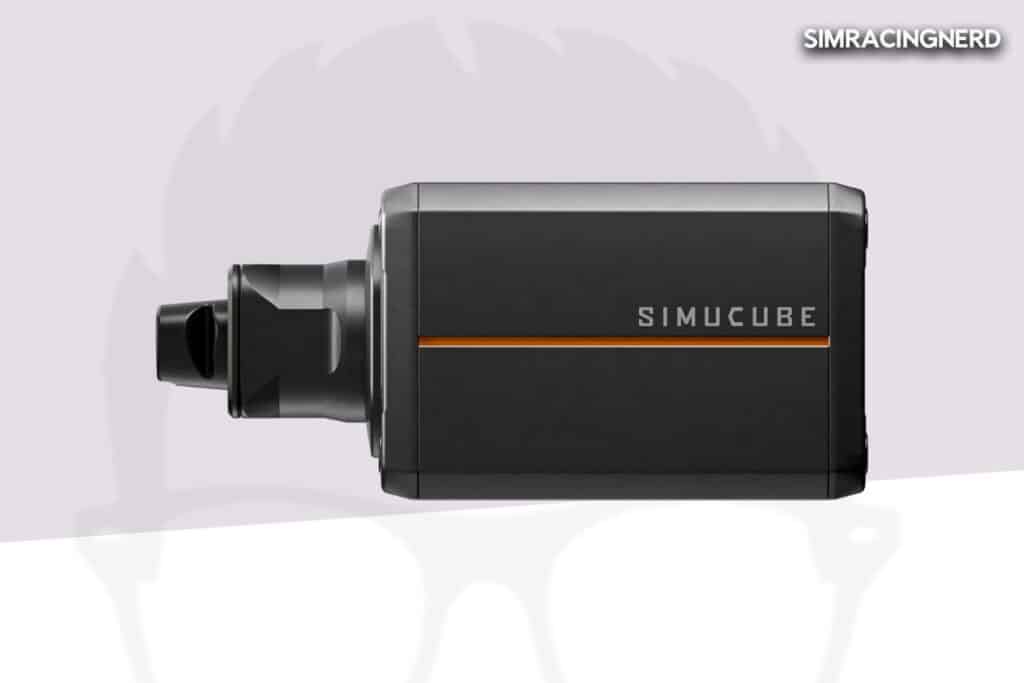
The Simucube 3 Pro is a carbon copy of the 3 Sport, with the only difference being its size. As a result, the 3 Pro is 25 mm longer and 2.3 kg heavier, weighing in at exactly 8.7 kg for the Sport and 11 kg for the Pro. As for the rest of the design of the two bases, it’s all copy and paste. In fact, this is nothing new at Simucube, since the bases in the 2 range (except the Ultimate) are also identical to each other, and the differences are in length and weight.
Let’s move on to the technical specifications of the 3 Pro. As mentioned above, the new Simucube bases, with the exception of the Ultimate, use an SPM motor. The power of the 3 Pro is the maximum the motor can develop, i.e. 25 nm of torque.
The encoder is still 23-bit, with a power consumption of around 280 Watts. Frankly, I don’t know how Simucube managed this, as the 2 Pro uses 450 Watts at peak to develop the same power.
Materials and build quality
Needless to say, the base’s components are made of metal. Whether it’s the casing, the front plate, the rear plate or the Quick Release, it’s all metal. This gives the device better heat dissipation, as well as a premium appearance, of course.
The finish is exemplary, just like its little sister. The base components are superbly machined, and fit together perfectly. Once again, Simucube has a reputation to uphold, and that’s not going to change with its new bases.
Value for money
The same trend continues on this point, with 2 variations of the Simucube 3 Pro: one with a hub that costs €1,623, and one without a hub that can be exchanged for €1,523. In all honesty, the 3 Pro’s prices are in line with those of competitors such as Fanatec or Asetek SimSport.
So, as far as I’m concerned, of the three Simucube 3 bases (Sport, Pro and Ultimate), the Pro offers the best value for money when compared with peripherals of the same power level.
The Simucube 3 Ultimate
Design and features
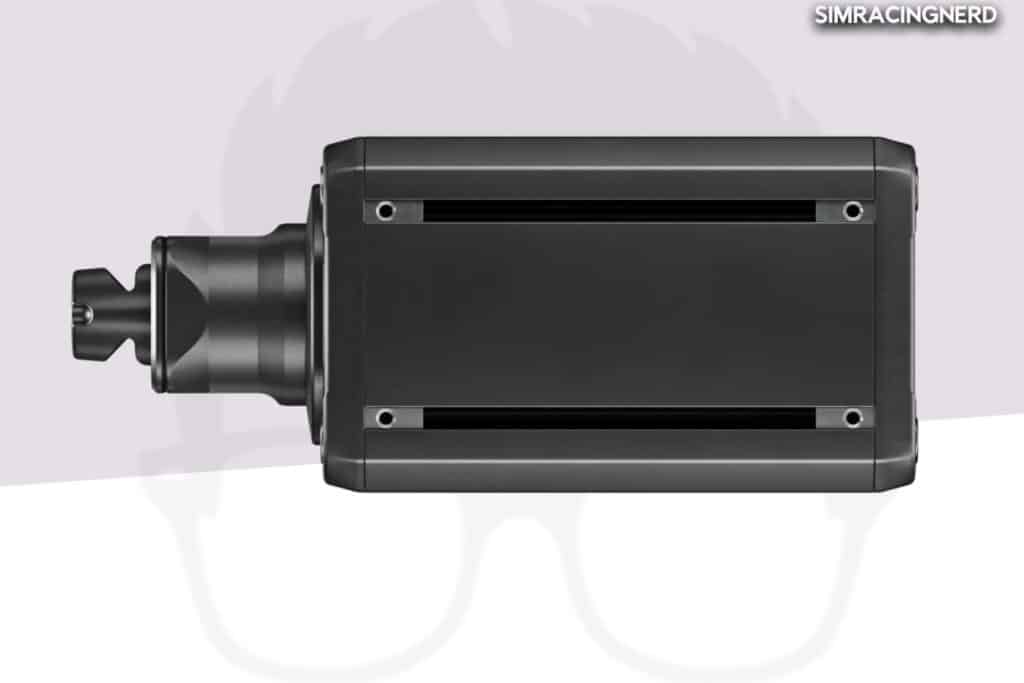
Let’s move on to the final Simucube 3 boss, the Ultimate. This is the brand’s top-of-the-range model, and strangely enough, the design remains unchanged. The base is just 20 mm longer and 2 kg heavier than the 3 Pro. The pencil stroke is identical, still the same gray color, and the QR on the front is the same. I have to say that this is slightly surprising, as the 2 Ultimate has a different design to the 2 Sport and 2 Pro. It’s not radical either, but there’s a visual demarcation between the Simucube 2 bases.
In terms of features, the electric motor is not the same this time. It’s called IPM, and develops up to 35 nm of torque. The encoder is still 23-bit, but the big change here is power consumption. On average, the base uses 360 Watts, with 450 Watts at peak, and if we compare these figures with the 2 Ultimate, the device is more than twice as efficient as the one it replaces, since the 2 Ultimate consumes 1000 Watts to generate 32 nm of torque.
Value for money
Let’s finish with the price/performance ratio. The 3 Ultimate is priced at €3395 with the hub and €3295 without.
If we’re talking purely in terms of numbers, the 3 Ultimate costs twice as much as the 3 Pro, but in the end develops only 10 nm more. Will you need 35 nm of torque for sim-racing? Probably not, unless you’re racing for a GT or Formula team.
However, the main purpose of such a chainstay is not the power it shows compared to the competition, but how you use the torque. You’ll almost never get saturation on the 3 Ultimate, and some riders are looking for that element. And of course, passion is priceless.
0 Comments