
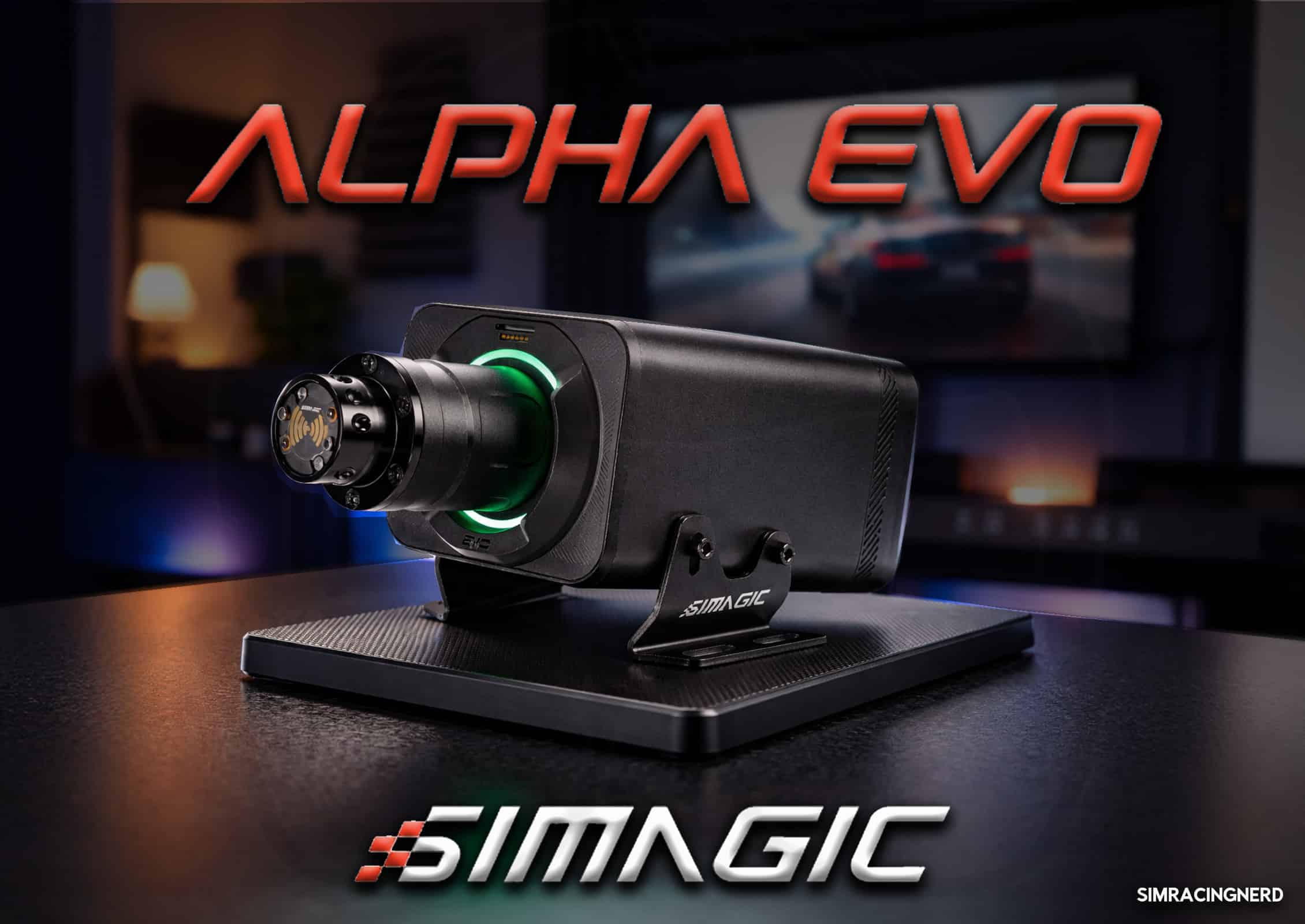

There are many manufacturers of sim-racing peripherals on the world market, with some brands we know well, and others not so well. Simagic belongs to the former group, with a worldwide presence.
The manufacturer’s catalog mainly targets two categories of virtual racers: those with riding experience and advanced riders. As a result, Simagic’s products target the mid- to high-end market, with Direct Drive chainstays with up to 23 nm of torque, hybrid Load Cell and hydraulic cranksets, and other peripherals such as a shifter, gearshift lever, etc.
This is a premium brand, with high-quality, high-performance products that are, above all, well-priced.
Among the products in Simagic’s catalog are bases that fill the gap in its range. These are the Alpha Evo peripherals, an evolution of the Alpha Mini, Alpha and Alpha U bases. Simagic now offers DD bases ranging from 9 nm torque to 23 nm, with 10, 12, 15 and 18 nm in between. Gone are the days when the brand targeted just one type of runner, for now it’s a whole range that’s affected.
In what follows, we take a look at the new Alpha Evo bases in their 3 power levels.
The 9 nm Simagic Alpha Evo
Design and features
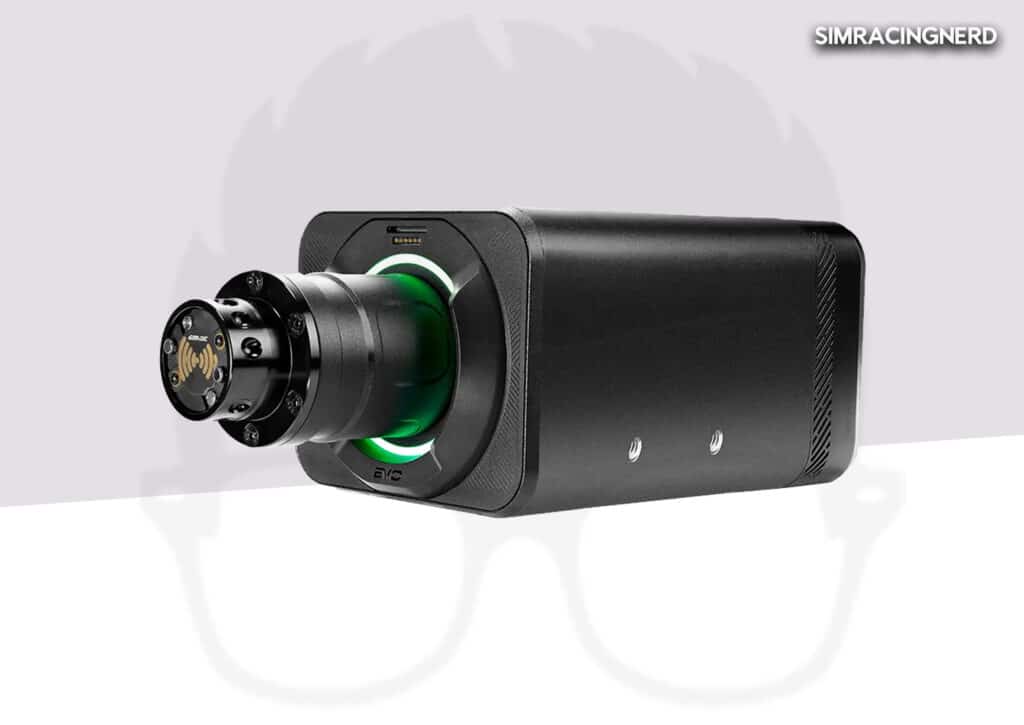
Let’s start with the design of the 9nm Alpha Evo. Compared to the Alpha Mini, the less powerful Evo, like the other bases in this new range, is radically different. Gone is the square look, and hello rounded edges. Frankly, I like it, as it gives the base a more minimalist, modern look, less like a prototype taken from a racing car.
On the front panel, you’ll notice the RGB ring around the drive shaft, which is used to create customizable lighting effects. As far as I’m concerned, I’m in favor of a discreet setup, but the RGB doesn’t show so much with a steering wheel in front to hide it.
On the top of the housing, the Simagic logo can be seen just behind the drive shaft, and the Alpha logo at the rear.
Let’s move on to the base’s characteristics. The motor delivers 9 nm of peak torque, and is backed up by a 21-bit encoder this time, up from 18 on previous bases, which are still on the market, and Zero-Cogging technology, which eliminates the “resistance” effects that come from an electric motor and its basic operation.
Materials and build quality
With its DD base, the 9 nm Alpha uses metal on its casing to help dissipate heat from the motor and electronics. The metal is lightly textured to give a beautiful tactile effect, enhancing the device’s build quality and premium appearance.
In terms of finish, this is a handsome device that reflects the brand’s premium image. You won’t notice any manufacturing defects, poorly assembled parts or parts that are slightly out of sync with the rest of the base. In a few words: the Alpha Evo 9 nm is a premium base, worthy of Simagic’s standards.
Value for money
For the base price, the Alpha Evo 9 nm trades for around €530. So, on paper, it’s more expensive than an 8 nm CSL DD, but less than an 8 nm GT DD Pro.
Compared with a Moza R9 V3, for example, the Alpha Evo 9 nm is €130 more expensive, for the same power. However, Simagic offers much more racing-derived peripherals, which is why its new base is more expensive than the competition.
Nevertheless, I find that the Alpha Evo 9 nm offers decent value for money.
The 12 nm Simagic Alpha Evo
Design and features
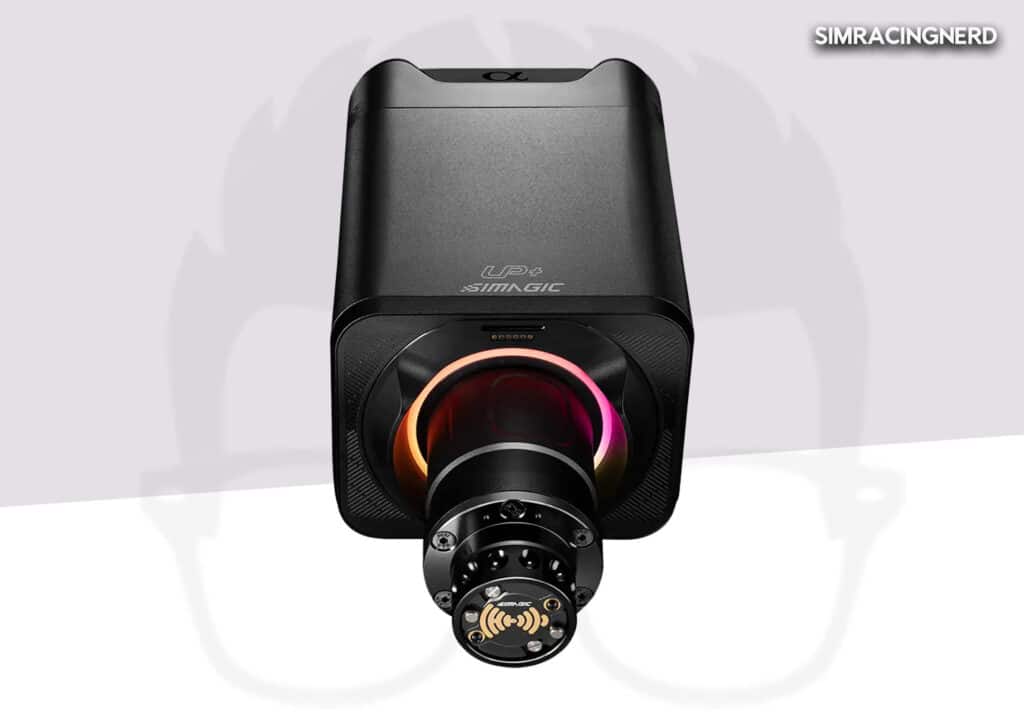
For the 12 nm Alpha Evo, the recipe is identical to Simagic’s small base. The design is the same, with rounded edges, RGB on the transmission axis and minimalist visuals. Once again, this base is beautiful, all-purpose and will go perfectly with any sim-racing setup.
Talking about the technical specifications, the same electric motor is used, but this time it develops 12 nm of peak torque. In fact, this is the case with all Simagic Direct Drive bases, and they deliver maximum power, not continuous power as with some Fanatec peripherals, for example.
Alongside the electric motor, we have Zero-Cogging technology to eliminate jerking, and a 21-bit encoder too. On this range of sim-racing peripherals, notably the DD bases, I’d say it’s standard what we find on the 12nm Alpha Evo.
Materials and build quality
Unsurprisingly, it’s based on the same design as the 9nm Alpha Evo, namely a metal housing that gives the device a premium look and helps cool the on-board electronics. Admittedly, there are slots at the rear, but the casing acts as a large radiator for engine heat exchange.
In terms of build quality, once again we’re dealing with a premium product. Everything is well assembled, the materials are of high quality and the finish is exemplary. To tell the truth, we’re used to seeing this from Simagic, and it doesn’t really change the brand’s standards.
Value for money
This mid-range base is priced at around €620, making it cheaper than the Fanatec ClubSport DD, which develops the same power, but not in the same way. However, the Alpha Evo 12 nm is more expensive than the Moza R12 V2, and these two bases are in the same category as far as I’m concerned.
It’s true that it’s a little more expensive than Moza, but I find that it’s much more geared towards sim-racing enthusiasts than casual drivers.
The 18 nm Simagic Alpha Evo
Design and features
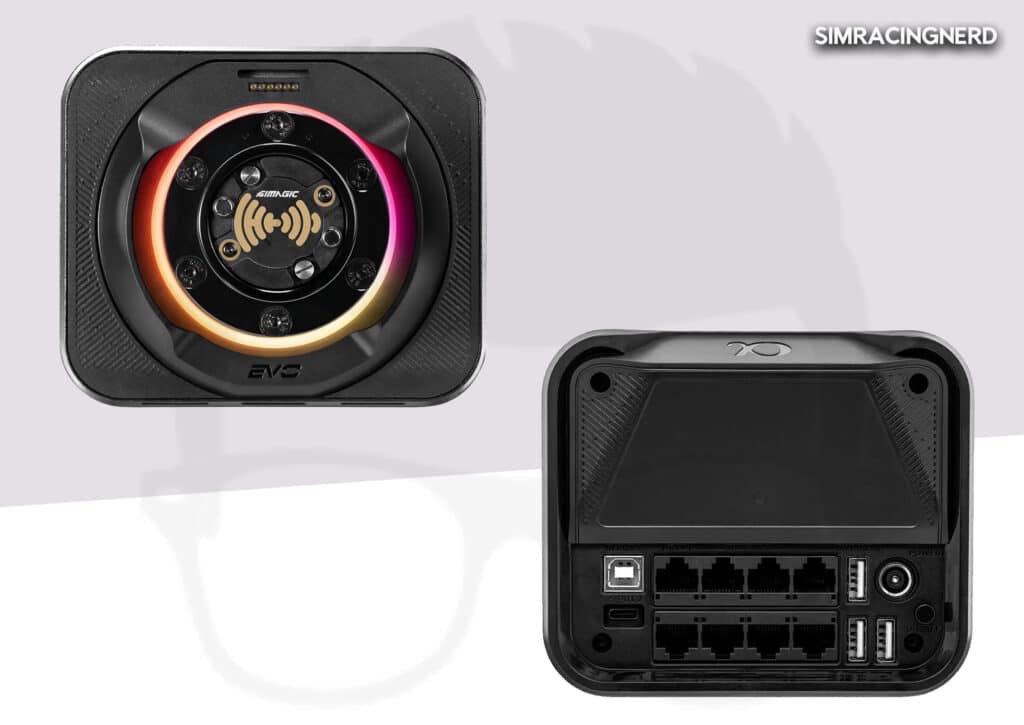
Let’s finish with the most powerful base of the Alpha Evo range, and this one develops 18 nm of peak torque thanks to its larger electric motor (you can see it on the casing), a 21-bit encoder and Zero-Cogging, which are still there.
In terms of design, there’s one slight difference between this base and the other two, and that’s size. Visually, they’re the same devices, but the 18 nm is a little longer than the other two, and heavier too. That’s how you can tell the difference between Simucube’s new bases, and Simagic has taken the same route.
Value for money
There’s no need to talk about the build quality and materials of the Alpha Evo 18nm, because it’s all the same as the other bases. So let’s get straight to the wallet. The base sells for €840, and frankly, it’s well positioned against the competition.
Fanatec opposite offers the ClubSport DD+ with 15 nm, as well as the Podium DD with 20 nm, at around €1,000. And here Simagic slips in between the two devices, with power right in the middle and a very attractive price.
As a result, and this remains my opinion, the Alpha Evo 18 nm offers great value for money, especially if you want a sweet spot device in terms of power.



0 Comments