
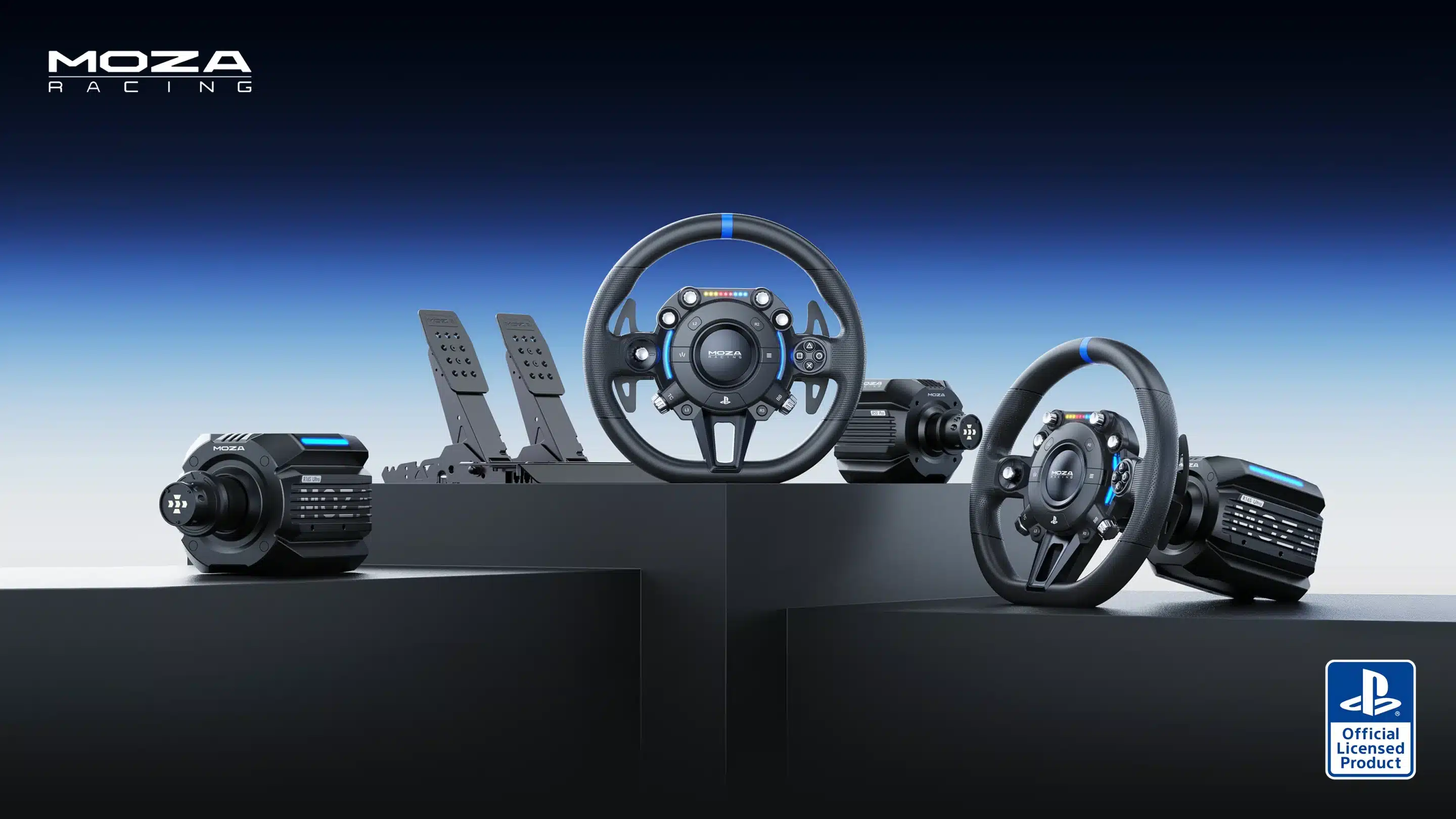

MOZA has officially unveiled its first PlayStation-licensed product line. Three products, two bases, and native support for Gran Turismo 7 starting at launch. The announcement took place on September 17, 2026, at the Tokyo Game Show, featuring the R5S Pro and R16S Ultra.
A comparison with Fanatec and Logitech will have to wait until the prices are announced. The most interesting question lies elsewhere: why did it take so long for this lineup to materialize, and what does the equipment shown reveal about the work done with Polyphony?
The “S” suffix refers to a feature that the PC version does not have
On July 1, 2026, an FCC filing by Shenzhen Gudsen Technology, the manufacturer of MOZA, revealed two unknown product codes: R5S Pro and R16S Ultra Direct Drive Wheel Base. The names had been registered well before Tokyo.
The key detail can be found in the test documents. The R16S Ultra and the R16 Ultra sold for PC use are based on identical electronics and modules. There are three differences: the name, the software version, and an encryption chip that only the “S” model includes.
An official console device must authenticate itself to the machine using dedicated hardware. MOZA has never stated that this chip is Sony’s, so we’ll stick to the regulatory requirements. However, this does resolve a question many people had: a software update will not make an R16 Ultra PlayStation-compatible. The necessary component is not there.
Two control dials that showcase the collaboration with Polyphony
MOZA mentions a controller developed in collaboration with Polyphony Digital, with native support in Gran Turismo 7. The official visuals show what it looks like, and it’s more polished than a simple port.
The steering wheel is round, with four PlayStation symbols on the hub, the console logo at the bottom, L2, R2, L3, and R3 buttons, an LED speed indicator strip, and two large paddles. It’s solid—nothing unexpected so far.
The details are below. Two dials flank the lower part of the hub, labeled TC and BB. Traction control and brake balance. These are precisely the settings that *Gran Turismo 7* lets you adjust while behind the wheel during a race. Kazunori Yamauchi said he wanted a steering wheel designed specifically for Gran Turismo rather than an existing product made compatible. On this point, the hardware proves him right: those two dials aren’t there by chance.
There is one indication to the contrary: the press release makes no mention of a Gran Turismo logo on this hardware, whereas the Fanatec GT DD Pro and GT DD Extreme feature one. The controller developed with Polyphony may be a separate product, still to come.
The fact that the base is sold separately raises the real question
MOZA also sells the R16S Ultra as a bare unit, which, in its own words, is meant to be paired with a compatible MOZA steering wheel of your choice. Compatible—but which one? No list is provided with the package.
Yet that’s where the future lies: on consoles, certification covers the hardware—not just the base unit—and the number of MOZA steering wheels that pass certification will determine whether the ecosystem takes off.
And the issue goes beyond steering wheels. MOZA presents its catalog as a complete ecosystem, featuring the mBooster Active Pedal, Active Shifter, and motion systems. The PS5 line includes bases, steering wheels, and a two-pedal set. The press release says nothing about the rest.
That leaves the price. Nothing has been announced for the PS5, but MOZA’s European store provides the closest comparison: the R5 Pro bundle is priced at €419 there, including the base unit, steering wheel, and pedals, and the R16 Ultra base unit alone is €549. If the console versions follow this pricing structure, MOZA would be offering the same value proposition as on PC.
For current owners, the situation is clear: the R5, R5 Pro, R9, R12, and R16 Ultra are compatible with neither the PS4 nor the PS5. Third-party adapters are available, but they do not provide native integration, and MOZA states that no official workaround is planned. The PS5 bundles already available therefore remain the only viable option, pending a release reportedly scheduled for late 2026.
So the question isn’t whether MOZA knows how to make a good base. We already know that. The question is how much of your current equipment will be compatible with it on the PlayStation 5.


0 Comments