
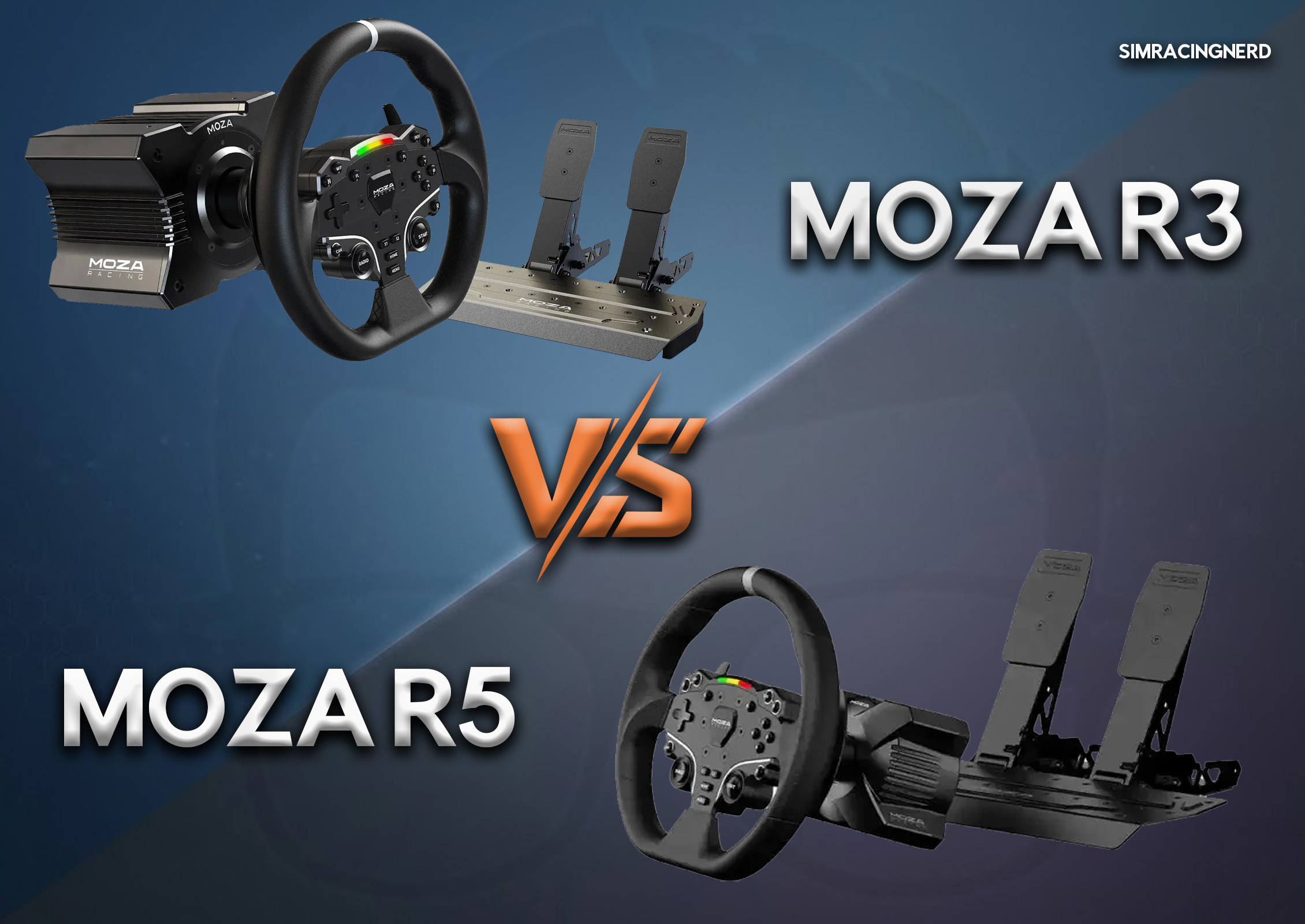

Moza Racing has made a name for itself on the sim-racing market in just a few years. The recipe for this success is both good and simple: offer peripherals that cover several sim-racing segments, perform well and are priced below the competition.
As a result, the brand rapidly gained market share and became a must-have in sim-racing, with collaborations with Xbox, Lamborghini and even Porsche. Moza’s current catalog is comprehensive, with bundles, DD bases, steering wheels, pedals, shifter, handbrake and even a range for truck sim and flight sim.
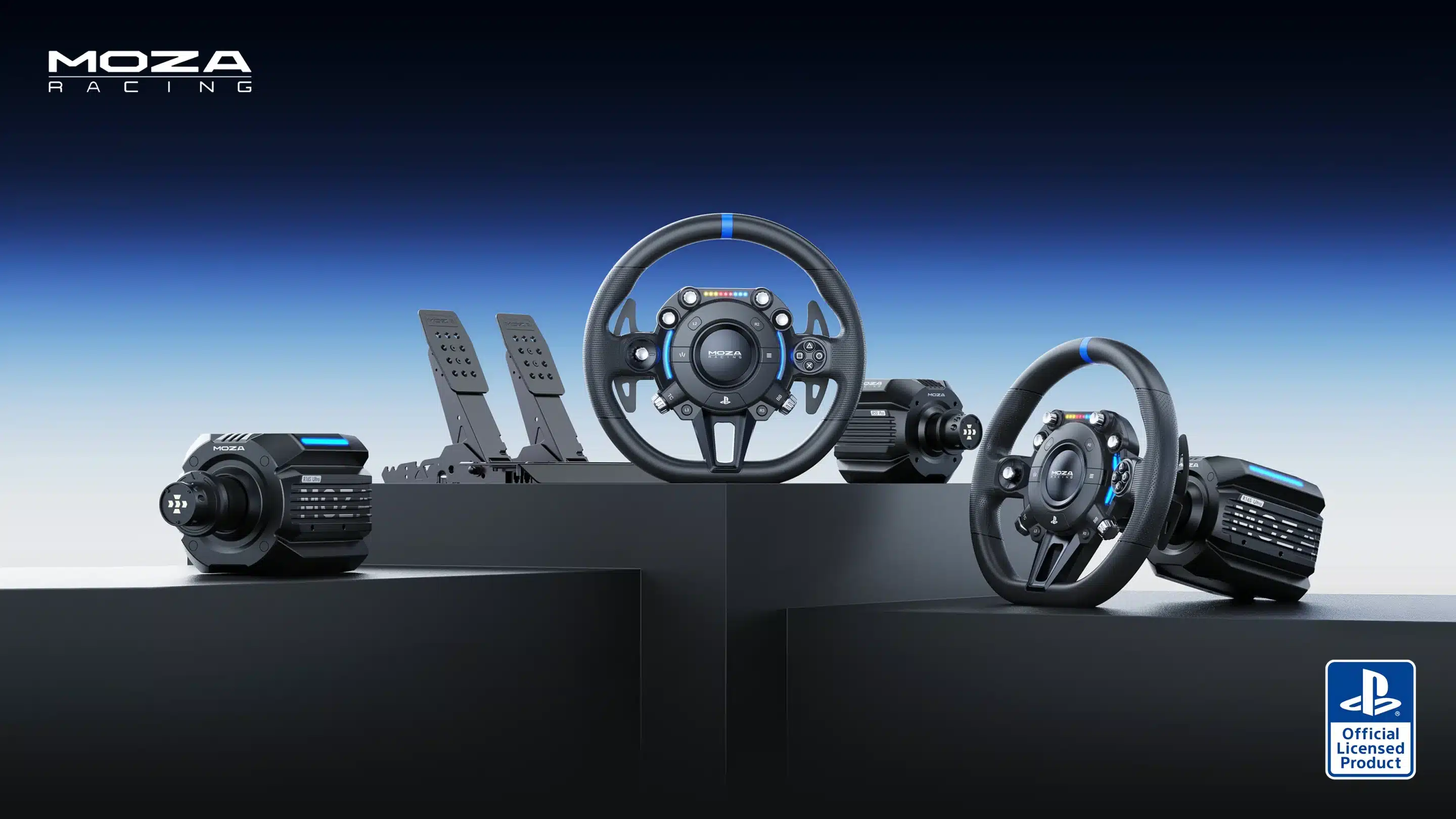
Moza’s bundles include the R3 and R5. They consist of DD bases developing 3.9 and 5 nm of torque respectively, a steering wheel and a pedalboard. These two bundles are aimed at the entry-level for the R5 and the console segment for the R3. Let’s see what they have to offer and which one is best suited to your virtual racing.
Design and build quality
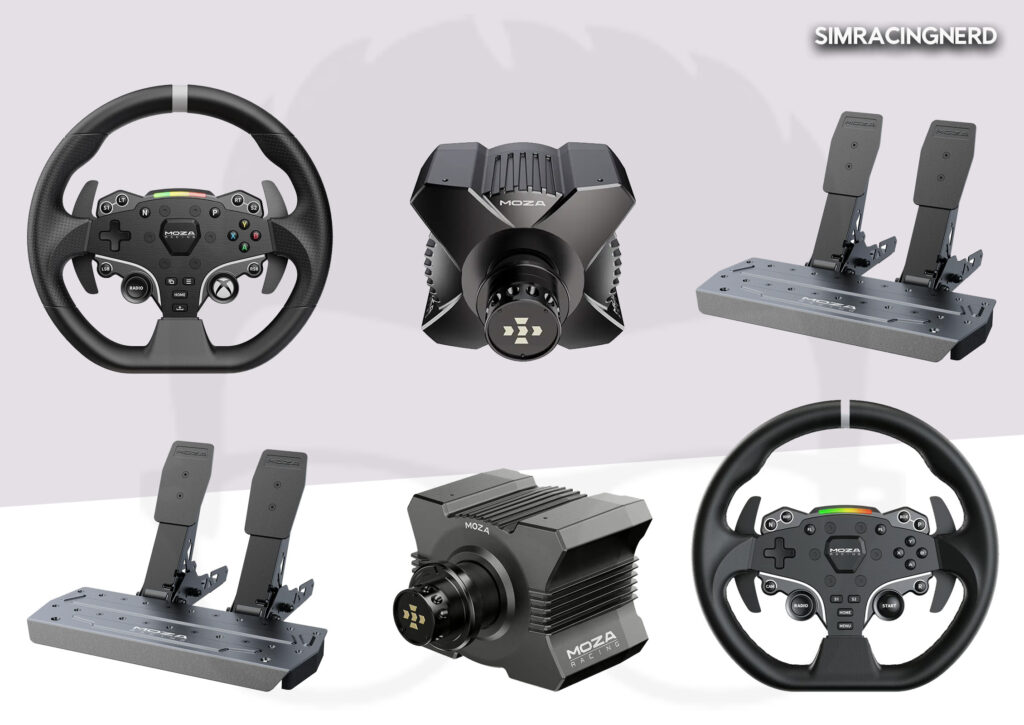
The base R3 and R5 are very similar, with an “X”-shaped design. The R5 is much squarer, while the R3 tends towards curves. On the whole, however, there’s a clear resemblance between the two, and they come from the same manufacturer. Moza has used well-made materials on the R3 and R5. Both bases are made of metal, as is the structure of both steering wheels.
The steering wheels are more or less the same. On the R3 it’s the ESX, and on the R5 it’s the ES. The ESX is basically a cheaper version of the ES. The ES is finished in aluminum and leather, while the ESX incorporates plastic and PU, which is a type of plastic.
The steering wheels are flat-bottomed, with a slight difference in color. The ESX is a hair darker than the ES, but both wheels look very good, I must say.
Let’s move on to the crankset that equips the R3 and R5 bundles, in this case the SR-P Lite. It’s a metal device, black and visually minimalist. It consists of a plate that acts as a footrest, and to which two pedals are attached.
In terms of build quality, I have to say that these two products are well made. Admittedly, they’re not on the same level as a Simagic or Fanatec, but they’re not far behind either. Moza positions itself as a very competitive alternative, and it’s frankly qualitative for the price.
Customized assembly
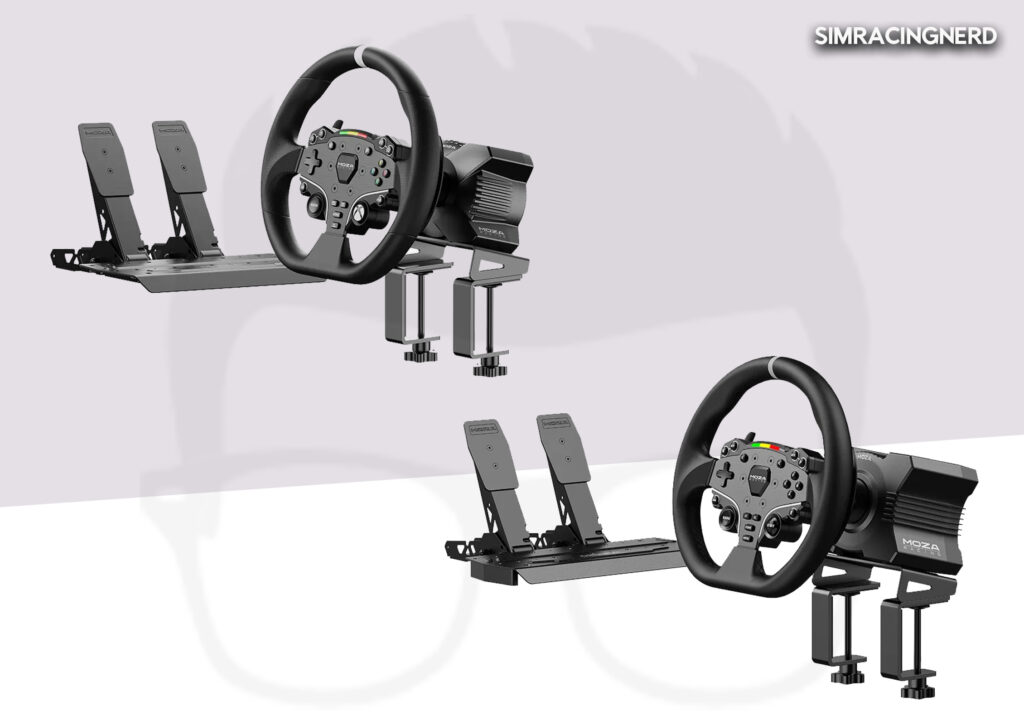
The bases use a bottom-mounting system on the decks, but Moza offers clamps with these two bundles to ensure attachment to tables or desks. The clamps offer a solid grip, thanks in particular to two screws for tightening.
The steering wheels use Moza’s Quick Release, co-developed with Simagic and derived from the D1-Spec. It looks a lot like a QR you’d find on a race car, and the connection between the steering wheels and the bases is excellent. It won’t move, there’s no play, no loss of connection and no movement on the drive shaft.
The SR-P Lite offers cockpit mounting via its two pedals, but it’s not really necessary to go this route if you don’t opt for the performance kit (LC). Nevertheless, the option is available, and it fits perfectly with all sim-racing setups.
Bundle ergonomics
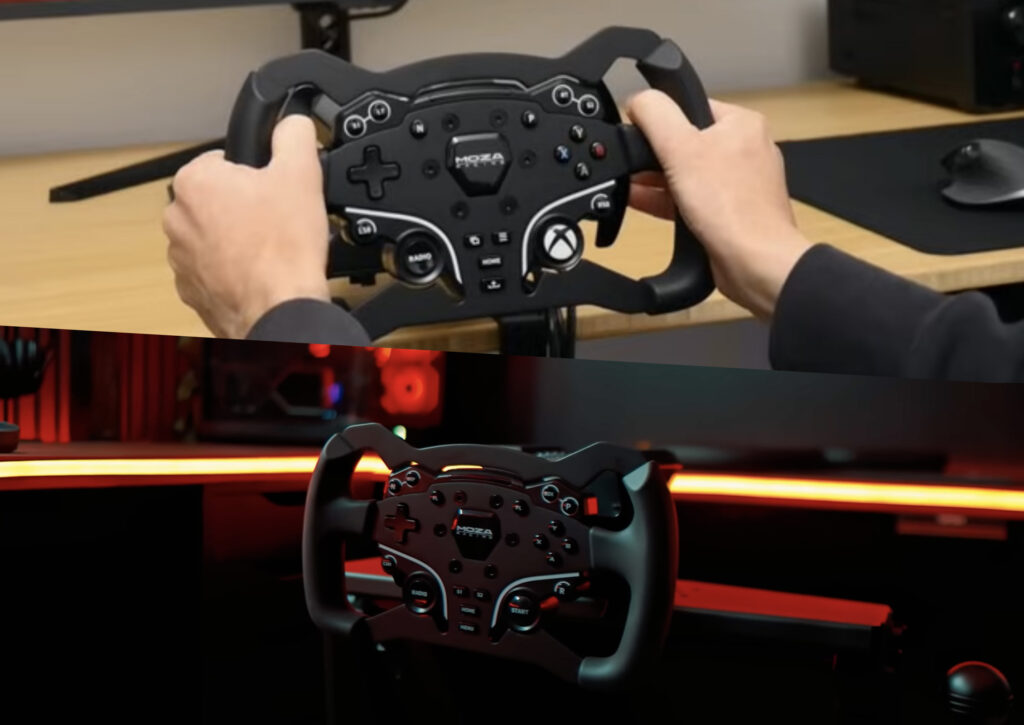
Since the R3 and R5 steering wheels are virtually identical, their ergonomics are the same. Wheel diameter is 28 cm, with a flat bottom. Controls are spread across the faceplate, and include 18 buttons, a D-Pad, a RevLED and two aluminum paddles at the rear. These are large, close to your hands, but are not magnetic due to the segment targeted by either the R3 or R5. However, the steering wheels are swappable, so you have the option of installing one with magnetic paddles.
For the SR-P Lite, the two pedals are adjustable in spacing only, which should be useful for accommodating different sim-racing setups. This is a very simple pedalboard, aimed at the entry-level virtual racing market. The pedals are linear and offer little resistance.
Sensation on the track
It’s time to talk about the on-track feel of Moza Racing’s R3 and R5 bundles. First and foremost, the bases are not aimed at the same audience. On the one hand, the R3 is much more geared towards chill drivers who want to have fun mainly on the console. On the other hand, the R5 is Moza’s “entry-level” PC base.
For the R3 bundle, the feeling is correct with the 3.9 nm of peak torque from the base. The device is communicative, with a good compromise between light and heavy effects. The base shines especially on arcade and sim-arcade titles, such as F1 or Forza (Horizon and Motorsport to some extent). But as soon as you start pushing it to its limits, clipping will appear, because the base is simply not powerful enough.
As for the R5 bundle and its base, the mix is better for sim-racing. The base develops 5 nm in peak, and proves to be talkative in racing. Between light effects, heavy effects and everything in between, the R5 is a good base for sim-racing beginners and amateurs. It’s a device that can easily tackle simulation titles thanks to its power, but also its software and firmware, which are up to the task.
As I said, the two bundles are aimed at different audiences, but this isn’t noticeable on the SR-P Lite crankset. Indeed, this is Moza’s entry-level device, and it comes without LC, or performance kit as the brand calls it. The throttle is a linear pedal, very smooth under your right foot. For the brake, there’s a semblance of resistance with a basic mechanism, which should push you to go straight to the performance kit. With the latter, the brake is better than on its simple version, and can easily compete with Fanatec’s CSL offering.
Value for money
The value for money of both is, frankly, very good, especially for the target segments. On the one hand, the R3 retails for €330 for the PC version and €400 for Xbox. The R5, on the other hand, is priced at €480, which isn’t very expensive on today’s market.
Both bundles use robust materials, benefit from good assembly and are well made overall. The price difference between the R3 and the R5 is justified above all by the power developed between the two bases, and also by the immersion that can be felt on the R5.
And if we compare these bundles with the competition, there’s no contest: the R3 and R5 are superbly positioned on the market. They offer a high-quality alternative to products from other competing brands, while being less expensive and having an Xbox option.
Which one to choose?
When choosing between the R3 and R5 bundles, you need to answer two questions: what are you looking for in sim-racing, and what is your level? If you only want to have fun on titles where the emphasis is on fun, with advanced car upgrades (especially aesthetics), as on Need For Speed or Forza Horizon, then R3 is a superb bundle for that. It’s compatible with PC and Xbox, depending on the version, and the feel is right for the titles in question.
But if your aim is to improve your sim-racing skills over several sessions, then you’d be better off with R5. It offers a more powerful, more communicative base and a more scalable platform. It’s the ideal choice for beginners and sim-racing enthusiasts alike.
0 Comments