
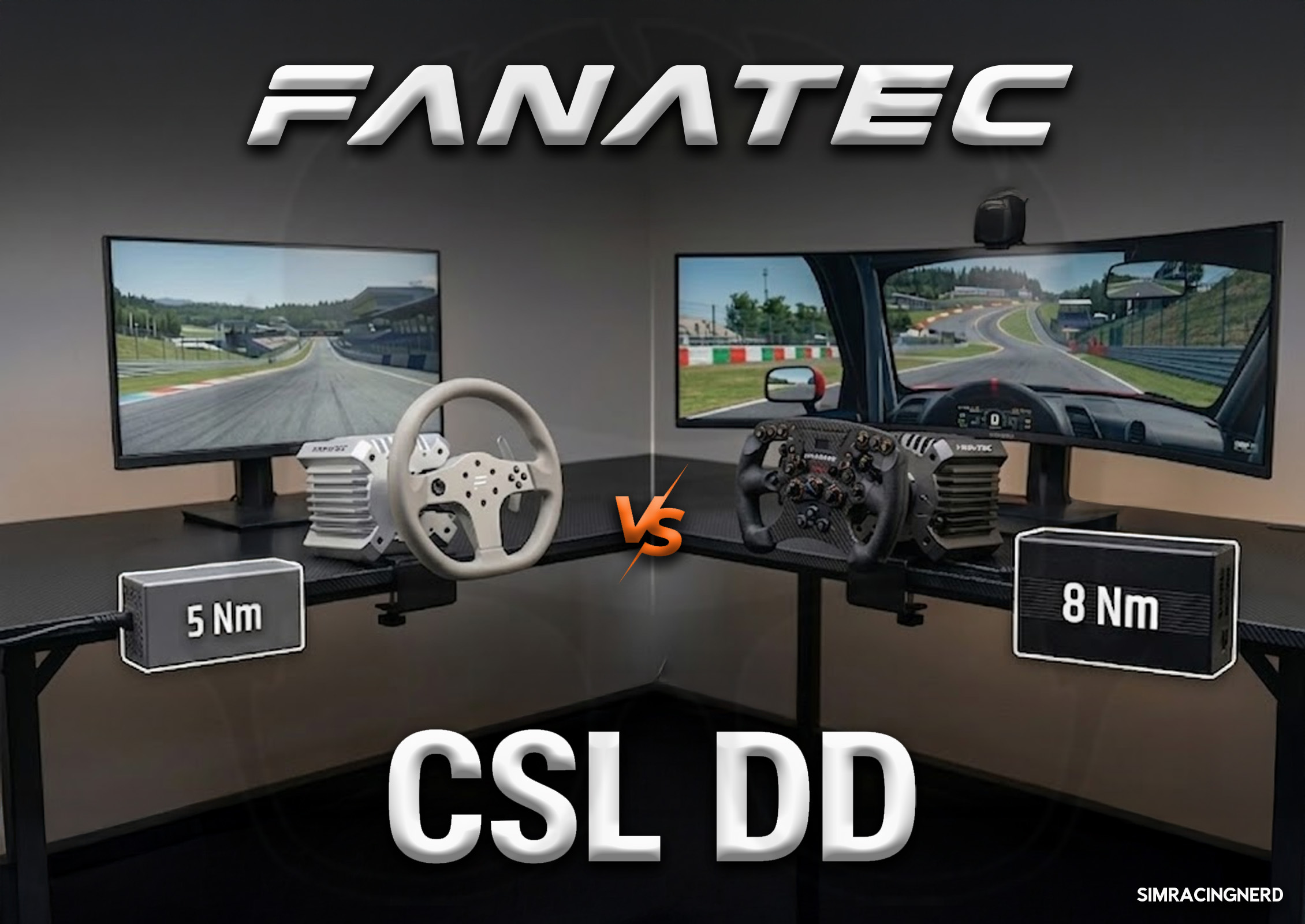

The sim-racing peripherals manufacturer Fanatec offers a complete range of products tailored to the needs of several categories of pilots. We have the CSL range, aimed at beginner or amateur sim-racers. The ClubSport is the go-to for drivers with a good deal of racing experience, and who are even seasoned, I’d say. For professional racers, the Podium range is for them.
One of the flagship peripherals in the CSL range is the DD base, which develops 5 and 8 nm of torque, depending on the power supply kit supplied. It’s a Direct Drive base designed for drivers who are new to sim-racing, or who enjoy virtual racing.
However, many people are wondering what to choose in such a situation. Is it better to start quietly with the 5 nm CSL DD and then move on to the 8 nm version? Or is it more practical to go straight for the 8 nm torque? That’s what we’ll look at below, with some advice on which to choose in the end.
Design and build quality
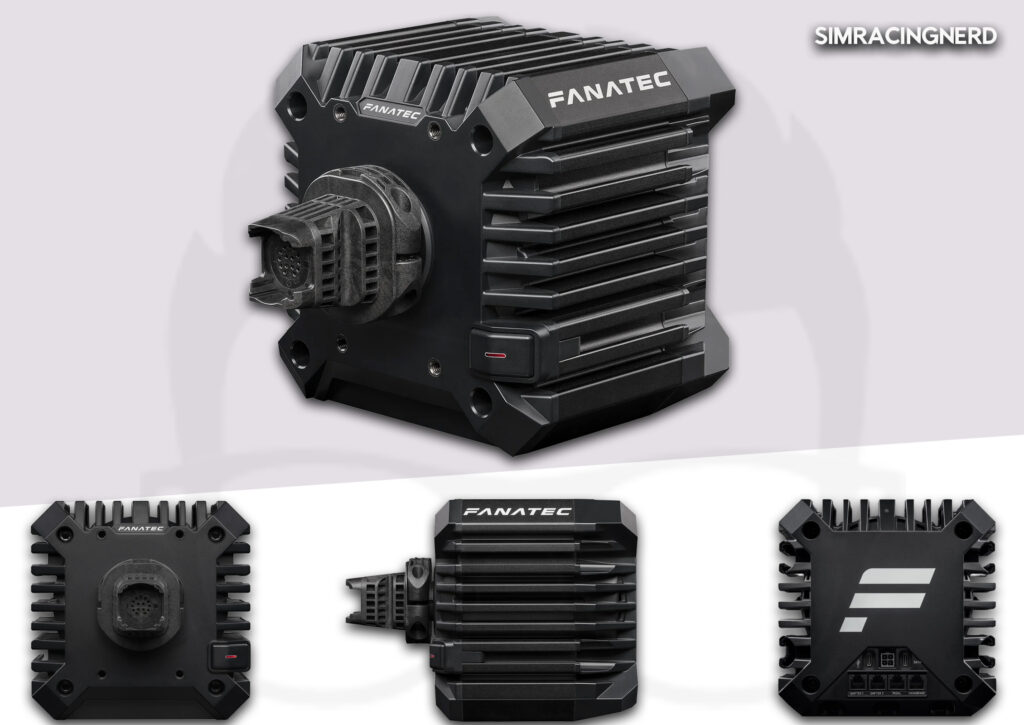
If you’re not already familiar with Fanatec peripherals, the CSL DD, whether in 5 nm or 8 nm version, is a single product available in two power levels. Only the power supply unit changes from one base to another.
In terms of design, the CSL DD is a square-shaped base with fins on all sides. The color black dominates the device, with a few Fanatec logos here and there. The fins are used to improve cooling of the base, but also to give the device a racing look.
The CSL DD is a fine basic model that fits in perfectly with Fanatec’s range of peripherals. Its larger siblings, the Podium DD and ClubSport DD and DD+, are very similar to it, and the result is truly homogeneous.
In terms of build quality, the base uses metal for the entire structure of the device to give it rigidity and enhanced heat dissipation. All parts of the CSL DD are well assembled, well manufactured and, above all, well finished. The CSL DD remains a quality base that is clearly premium compared to the competition.
Customized assembly
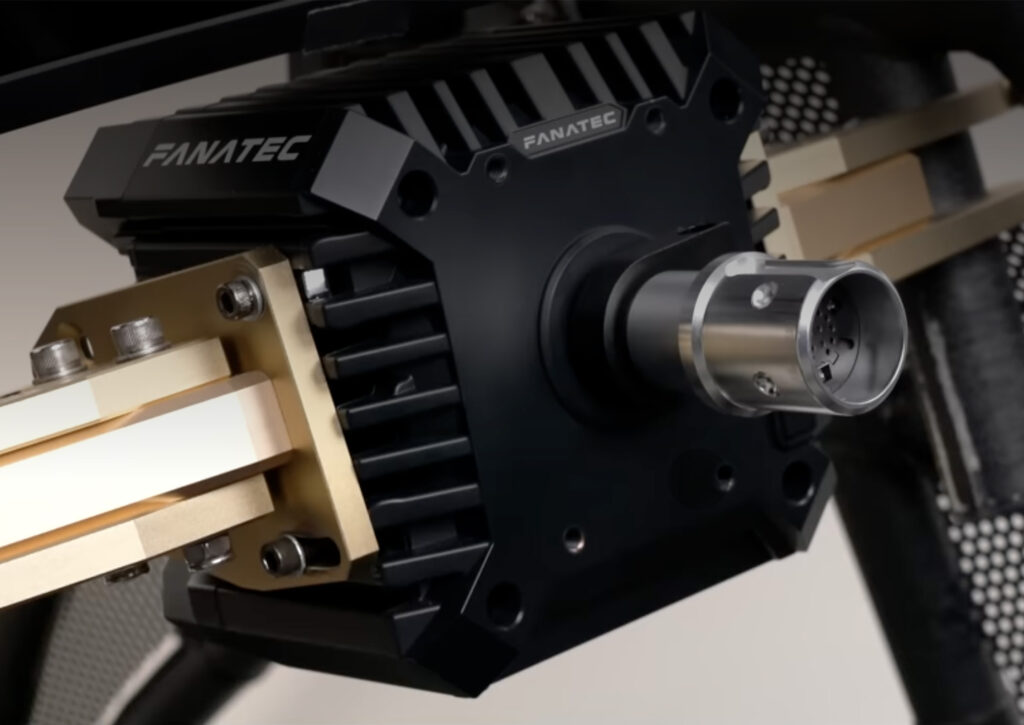
To mount the base to your setup, you have 3 general methods: front, side and bottom mounting. If you’re on a desk or table, you’ll opt for bottom mounting, as Fanatec offers a clamp designed for this purpose.
But if you have a cockpit, you can use the front or side mounting method, or even the bottom mounting method. It all depends on your chassis deck, because the CSL DD mounting will depend mainly on the cockpit.
And even if you opt for Fanatec’s signature clamp, the CSL DD’s attachment to furniture will be very good, for one simple reason: the base exerts a maximum of 8 nm of torque, which isn’t much for a good clamp.
Platform compatibility
The CSL DD in 5 or 8 nm versions is compatible with PCs and Xboxes. If you have a Microsoft console, you must acquire an Xbox-licensed Fanatec steering wheel. In fact, the chip that enables the base and steering wheel to be recognized by the Microsoft console is located on the wheel.
For PCs, there’s no limit to compatibility, except in terms of operating system, since you’ll need an OS that’s Windows 10 or 11. The steering wheel doesn’t matter when it comes to this platform’s support for CSL DD.
I’d like to clarify another base in the CSL range, the GT DD Pro. This is a base developed in partnership with Sony for official Gran Turismo licensing. This base, the GT DD Pro, is natively compatible with Playstation, PC, and also Xbox if you have the right steering wheel.
Sensation on the track
In terms of on-track feel, the two bases are virtually identical over part of the power range. Given that the electric motor and all the electronics are the same, you can imagine that feedback doesn’t change up to 5 nm of torque.
The 5 nm version of the CSL DD is therefore limited to this same maximum torque by its power pack. As far as sensations are concerned, the base is very communicative for everything the car you’re driving does, and what it also undergoes on the road.
The base transmits light and heavy effects faithfully, regardless of the sim-racing track you’re facing. ABS intervention, wheel lock, understeer, oversteer, etc. all pass through the base, and thus the steering wheel, which sends them back to you.
I should add that the CSL DD 5 nm is more accurate in sim-racing on PC, thanks to the FanaLab software, which offers much better parameter customization. But even on consoles, the CSL DD 5 nm is a very good device.
Obviously, the 8 nm version of the base allows us to push the product’s limits even further. You’ll therefore experience saturation later on, as well as clipping much higher up the power range. Nevertheless, the behavior of the CSL DD 8 nm is virtually identical to that of the 5 nm version, with a base that is healthy, communicative and precise on the run.
Value for money
Fanatec displays 2 different prices for the CSL DD, depending on the model you choose. The 5 nm base can be exchanged for 329.95 €and the 8 nm is €429.90.
The CSL DD 5 and 8 nm offer excellent value for money in the face of competition from Moza Racing, but also from Logitech and Simagic when Fanatec offers promotions.
Which one to buy?
Fanatec, with its CSL DD, is playing in a segment that is broadly divided into two categories of driver: those who come from a belt-and-gear drive base, love sim-racing and want to take the next step, namely the DD base. And those who are looking for the right sensations on the track, but don’t want to break the 10 nm torque barrier.
With the 5 nm CSL, it’s simply a superb device: it knows how to speak feedback, it’s beautiful, it can be improved, and it’s part of a more than complete catalog. What’s more, the 5 nm of torque is more than enough for a pilot who wants to gain experience slowly.
The second category of virtual drivers will naturally find that the CSL DD 8 nm is the perfect DD base for sim-racing. It pushes back the limits of the 5 nm version, without losing any tchatch. It offers smoother feedback at the upper end of the torque range, without clipping. So, yes, if you push it to its limits, you’ll feel some blurring at the wheel, just like on any DD base, whatever its power.
In a few words, here’s what I think of the CSL DD: if you’re new to sim-racing, especially on a direct-drive basis, go for the 5 nm version. And if you’re experienced in sim-racing, go for the 8 nm.
I should also point out that the boost kit is available for purchase on its own, enabling you to acquire a 5 nm CSL DD first, then upgrade to 8 nm.
0 Comments