

If you’re looking for a sim-racing cockpit, you’ve almost certainly heard of the SimLab brand. It’s a Dutch manufacturer that offers two lines of chassis, in addition to other sim-racing peripherals.
Among the cockpits available at SimLab are the GT1 and P1X series. For each series, the manufacturer offers two chassis variants: for the GT1, these are the Evo and the Pro, and for the P1X, these are the Pro and the Ultimate. SimLab also offers a chassis specifically designed for Formula racing, as it is an official partner of AMG-Petronas in F1.
Between the GT1 Evo, the GT1 Pro, and the P1X Pro, which one best suits your needs? In this article, we’ll take a look at these three chassis, their specific features, their build quality, and, most importantly, help you decide which one to choose.
Design and Build Quality of the Frames
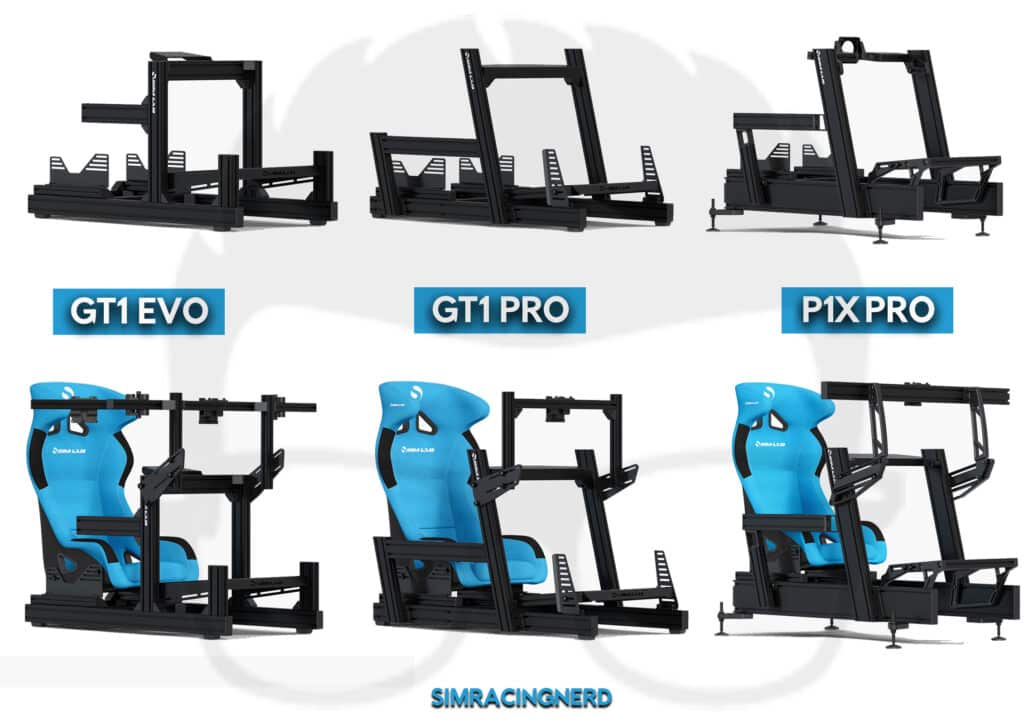
SimLab chassis are all broadly similar, with a few differences in design. The GT1 Evo is a very simple, all-black cockpit made of aluminum extrusions. The mounts are vertical, with rails for attaching additional accessories if needed. The base deck serves as a stand in its own right, as does the pedal mount. The GT1 Evo is a very upright chassis and, as mentioned above, minimalist in design.
The GT1 Pro features the same frame design as the Evo, but this time with mounts that are angled toward the rider. This is the most notable difference between the two frames, along with a shifter mount that is significantly longer than on the GT1 Evo. Additionally, the crankset mount is visually slimmer but offers greater customization options.
As for the P1X Pro, it looks much more like the GT1 Pro, with mounts that face the driver and a frame that’s much sturdier than on the other two cockpits. Why? Well, the P1X Pro is part of SimLab’s high-end lineup, and it’s designed to handle the most powerful sim-racing peripherals, in addition to being compatible with conversion to an active chassis.
Let’s talk about build quality. SimLab is known for offering premium peripherals, and these three cockpits are no exception—not even the GT1 Evo. They are well-made, CNC-machined, and carefully assembled.
Cockpit Settings
The GT1 Evo and Pro models offer adjustments to the Direct Drive base deck, both in height and depth. This also applies to the pedal mount, which features options for adjusting the angle and the distance between the device and you.
Both of these chassis come with bucket seat mounts that offer multiple mounting positions. As an option, you can order the GT1 Evo and Pro with slide rails if you’d like more configuration options for these two chassis.
Let’s move on to the P1X Pro. It features a fully modular frame and supports. This means that on the DD base deck, you can adjust the height, depth, and tilt. The pedal mount works the same way, with much more advanced adjustments than on the other two frames.
Compatibility with bottom brackets and cranksets
The list of Direct Drive bases compatible with the GT1 Evo and GT1 Pro is quite long, as long as you have a bottom-mounting system—whether directly on the base or using additional mounts—and the device does not exceed 25 nm of torque. This also applies to cranksets, and a comprehensive list is provided on the chassis page.
Since the P1X Pro is one of SimLab’s top-of-the-line models, compatibility with peripherals should be excellent—and I can tell you that it is. As for the DD base, you have three decks available as a free option when configuring the chassis: bottom mounting, front mounting, and a deck specifically designed for Fanatec DD bases.
As for the pedal assemblies, the list is just as long as for the other two frames, with compatibility for both load cell and hydraulic devices. The mounting bracket is large, which makes it easier to install the products and maintain them.
Options available for each cockpit
All three models share a sturdy aluminum profile base, which allows for universal compatibility with your own accessories (screens, third-party mounts) via the rail system.
However, the P1X Pro clearly stands out thanks to its standard features:
- Slides included: Unlike the GT1 Evo and GT1 Pro, where they are optional, they come standard, which reduces the actual price difference when configuring a complete setup.
- Flexibility of Direct Drive Mounts: The P1X Pro offers a choice of three mounts for Direct Drive bases (bottom-mount, front-mount, or Fanatec-specific) at no extra cost. This configuration flexibility is exclusive to the P1X Pro and saves you from incurring additional costs when customizing your cockpit.
In addition, all three chassis are compatible with a wide range of official SimLab accessories, including monitor mounts (single or triple) and a selection of four bucket seats (Sparco and SimLab).
The Sturdiness of the Frames
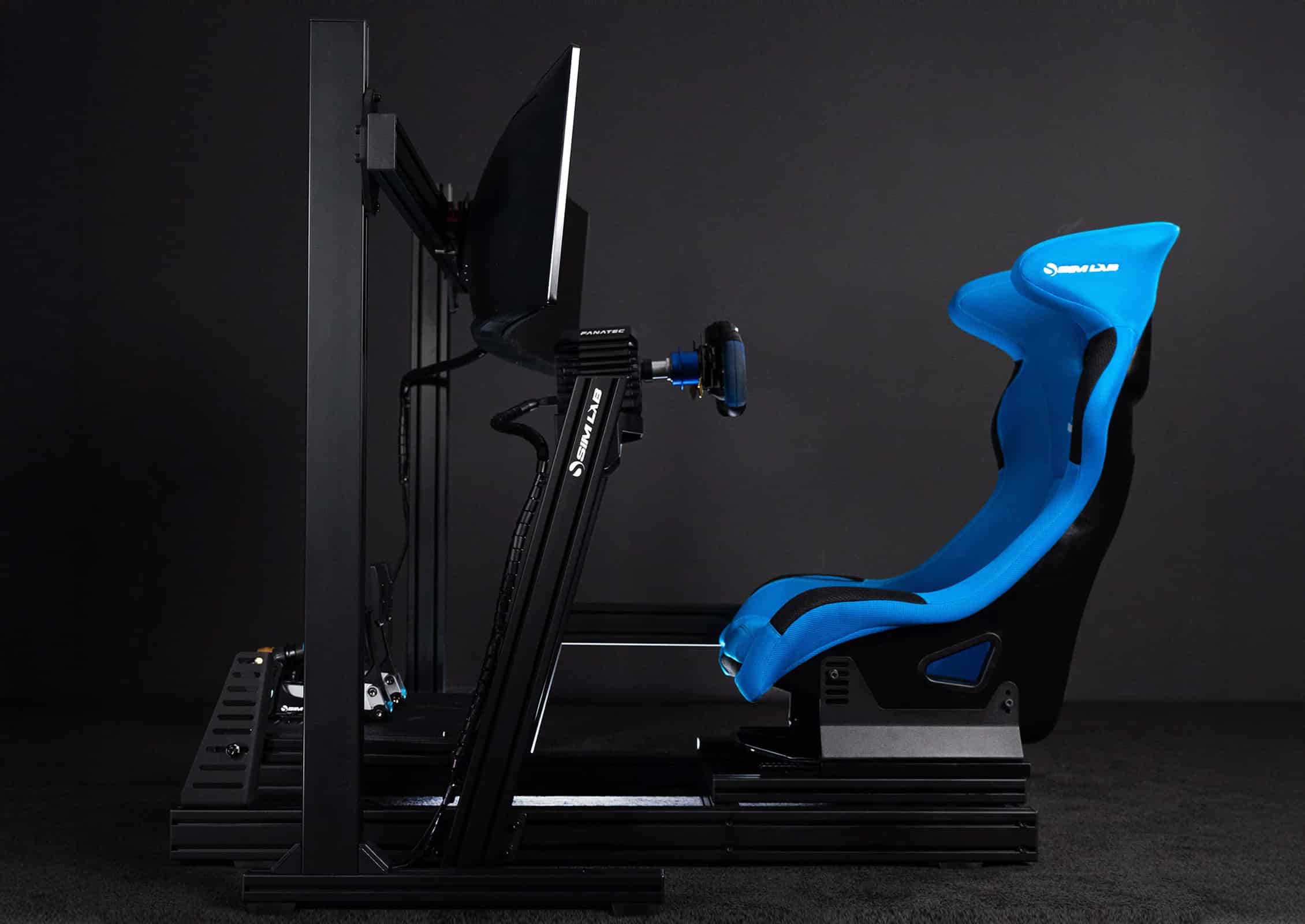
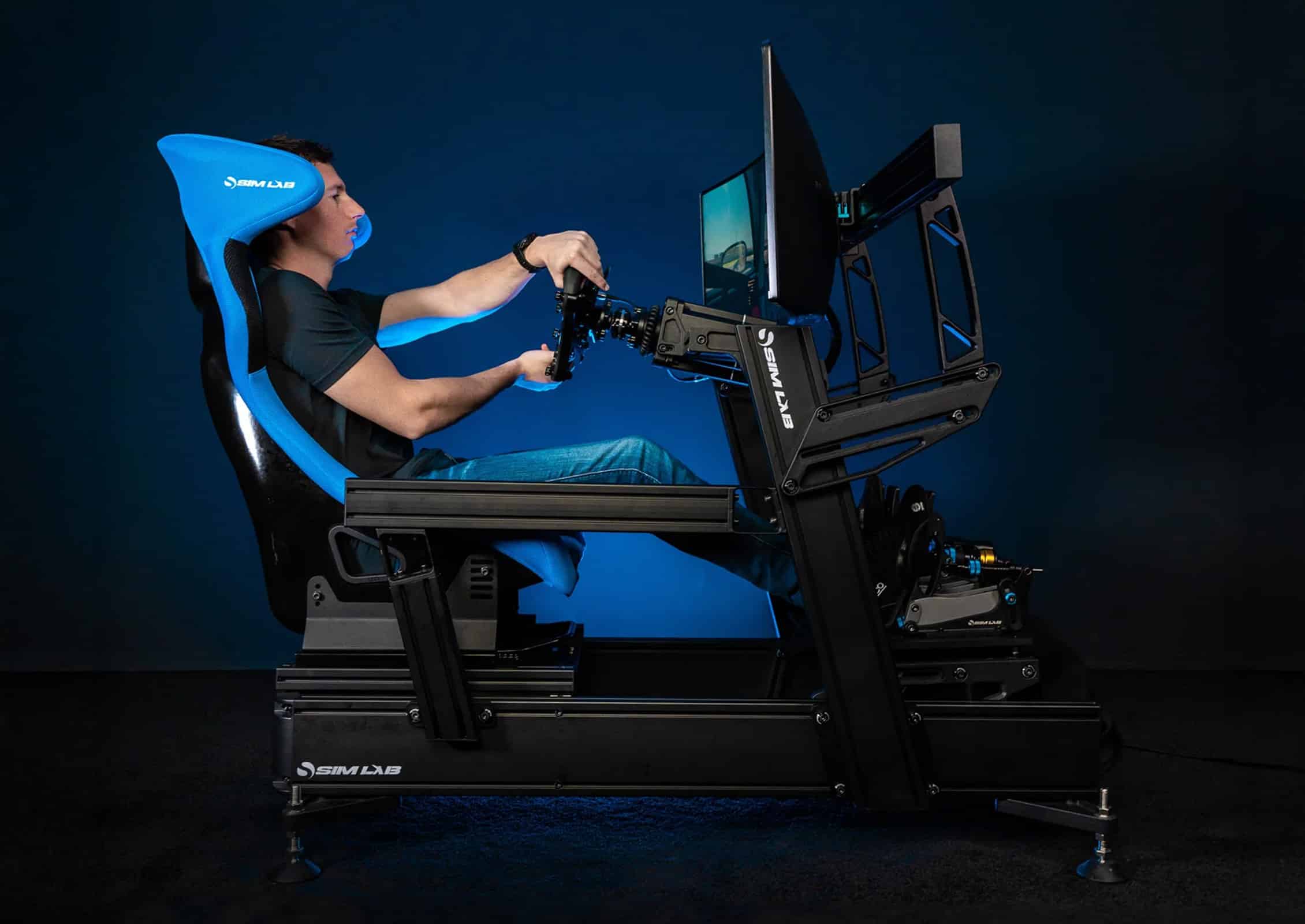
As mentioned above, the GT1 Evo, Pro, and P1X Pro models use aluminum extrusions in their frames. This gives them a high level of rigidity, allowing them to handle the most powerful direct-drive bases and LC or hydraulic cranksets on the market.
On the GT1 Evo and GT1 Pro, the power output limit for a DD base is 25 nm of torque, such as the Fanatec Podium DD or the Moza R25 Ultra. As for the pedals, they can handle up to 200 kg of load on the dedicated mount without any issues.
The P1X Pro is much more robust than its two smaller siblings, and it can accommodate DD drives with torque up to 35 nm, including the Simucube 3 Ultimate. As for the pedals, the limit is around 200 kg, because with a device like this, the key isn’t the force it can withstand, but rather the feedback it provides. What’s more, the P1X Pro is designed to be converted into an active chassis, which requires a very robust structure.
Value for money
As with any self-respecting SimLab chassis, the GT1 Evo starts at a low price in its bare-bones configuration—that is, without any options. If you opt for just the cockpit, expect to spend €379 on it. And if you choose the fully loaded configuration, the price quickly climbs to over €1, 400.
The same can be said for the GT1 Pro, which ranges in price from €649 to over €1, 650. And the P1X Pro is no different: a base price of 872 €, and over 1,750 € fully loaded with mounts for three monitors, a Sparco seat, and any DD base deck.
So yes, these are still expensive devices, especially when fully equipped. However, there’s no denying that SimLab’s chassis offer excellent value for the money, with a slight edge going to the P1X Pro.
Which one to choose?
The drivers these three SimLab offerings are aimed at are essentially the same, but there are differences, particularly in the end-game setup. If you’re new to sim racing or have some solid experience in virtual racing, then I suggest either the GT1 Evo if your budget is limited, or the GT1 Pro for those who don’t really want to compromise on an entry-level setup. The price difference for the fully loaded versions is about €250, which is actually a pretty good deal in sim racing—enough to upgrade your base direct-drive system, your pedal set, or to get a gorgeous GT-style steering wheel.
But if you’ve already logged hundreds of hours driving on virtual tracks and have a healthy budget to invest in a top-notch setup, then there’s no question about it: the P1X Pro is the one for you. The cockpit is extremely sturdy, capable of withstanding over 30 nm of torque on a DD base without wobbling. What’s more, it’s an excellent foundation for conversion into a dynamic chassis, blurring the line between virtual and real.
The P1X Pro is designed for seasoned drivers with extensive experience in sim racing. On top of that, this fully equipped cockpit is a better alternative to the other two models—particularly the GT1 Pro—since the price difference is only €100, but the final setup is far superior in terms of compatibility with sim-racing equipment, stability, and scalability.





0 Comments