
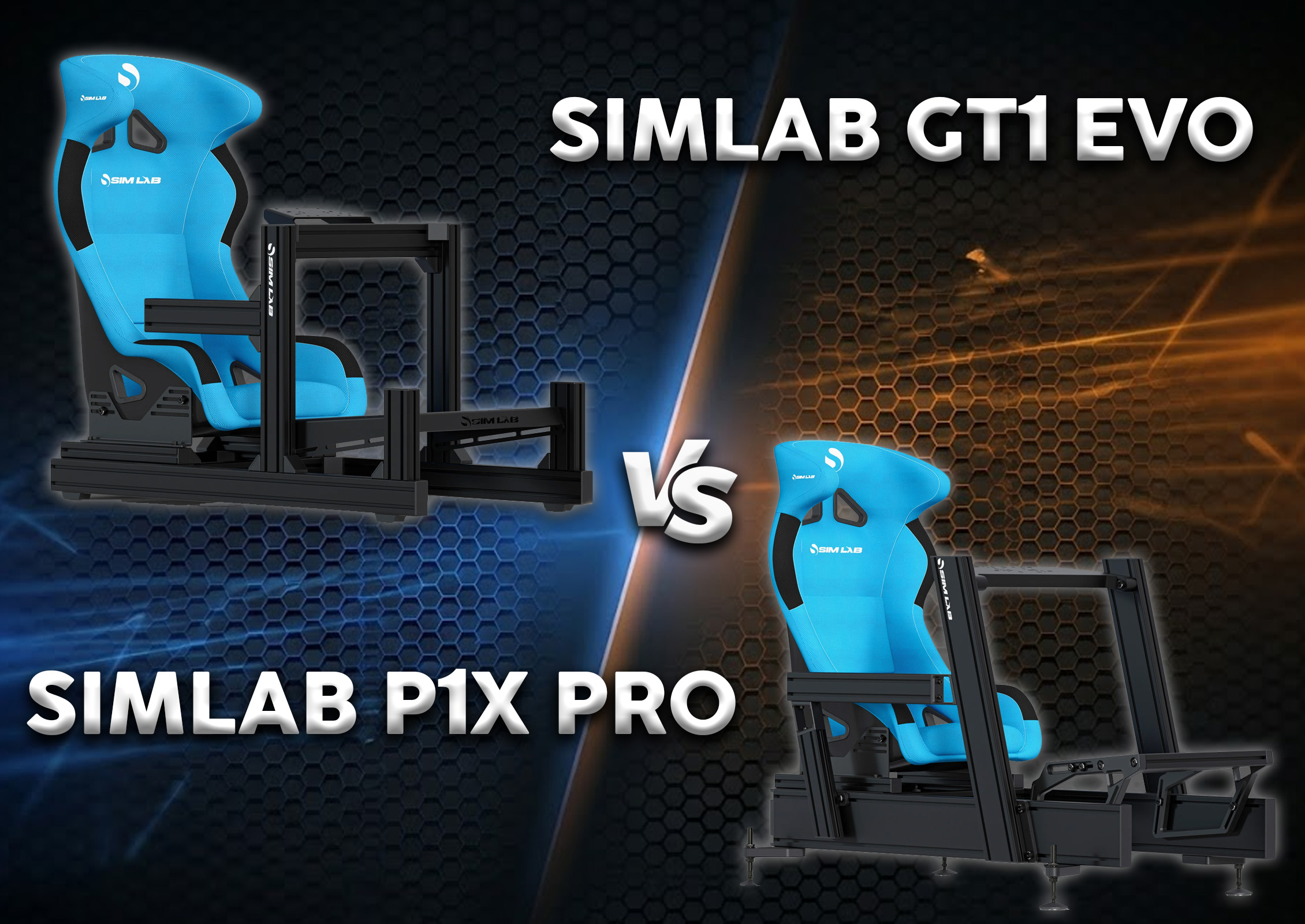

SimLab is a major player in the sim-racing cockpit market, with roots going back over 10 years. The European brand is known worldwide among sim-racing enthusiasts and fans, and is the official partner of the AMG-Petronas F1 team.
This Dutch manufacturer started out in the cockpit market, but has slowly expanded its range of peripherals. Today, its catalog includes not only cockpits, but also pedals, steering wheels, seats, handbrakes and gearshift levers, as well as aircraft flight simulators.
As for the chassis catalog, SimLab offers 3 products: the GT1, P1X and Formula cockpits. The first two are available in 2 versions, and today we’re going to take a look at the GT1 Evo and P1X Pro, which are the entry points to each cockpit range.
Design and build quality
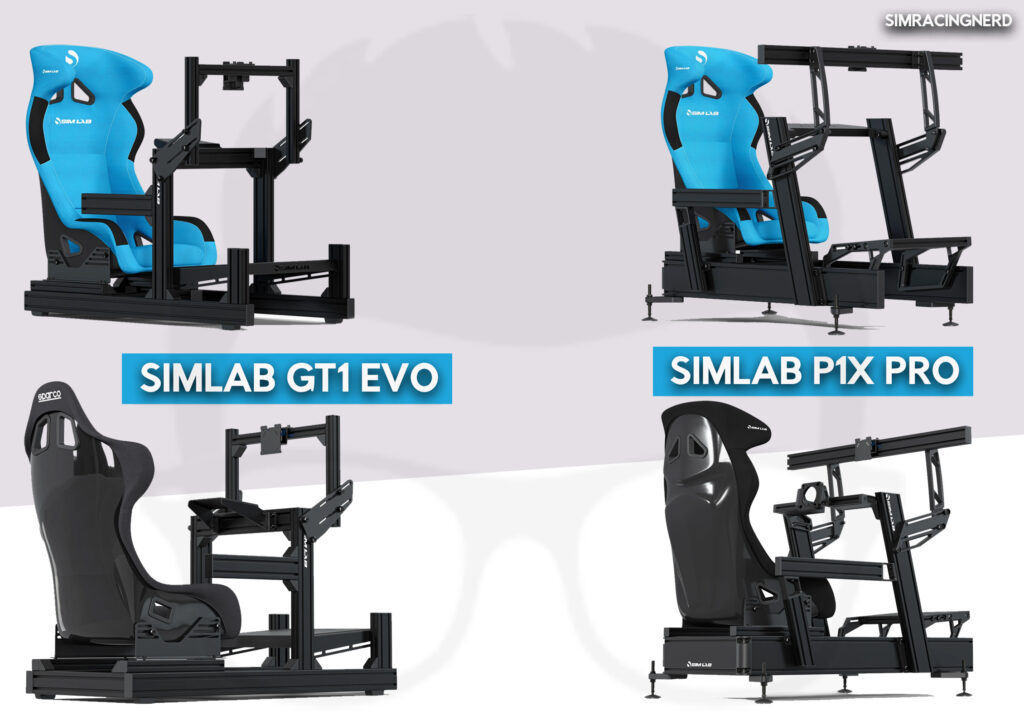
Aluminum profile chassis are very similar, and the GT1 Evo and P1X Pro are no exception. Both share main brackets that house the entire equipment structure, with additional brackets for base and bottom bracket decks.
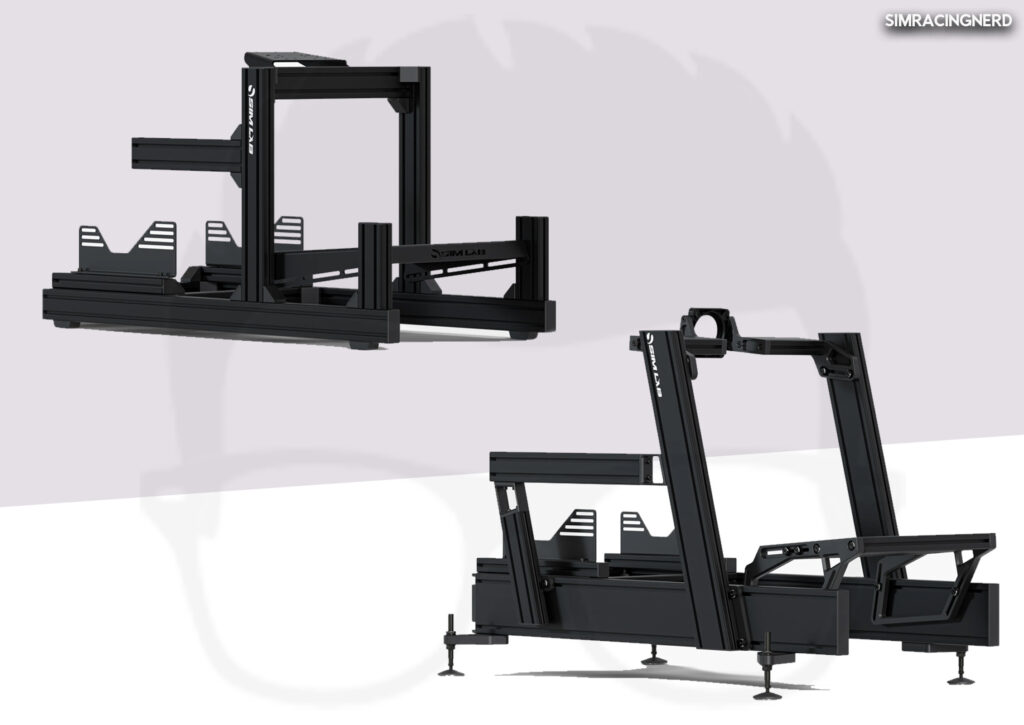
The GT1 Evo and P1X Pro are painted black, with only the SimLab logo on one of the vertical supports. The notable difference between the two is the vertical supports (for the base): on the GT1 Evo, they’re straight, while on the P1X Pro, they’re angled towards the driver to offer better ergonomics.
But otherwise, visually, the GT1 Evo looks simpler in terms of design than the P1X Pro, and it feels like the second chassis is clearly aimed at an audience with good sim-racing experience.
In terms of manufacturing quality, we’re talking about SimLab products, and therefore premiums, even if the base price may seem low compared with the competition. The tubes are made of CNC-cut aluminum profiles. Assembly is just perfect, and the equipment benefits from great attention to detail. You won’t find a poorly assembled, machined or finished part. Everything is meticulous, and that’s what I love about SimLab.
Customized assembly
SimLab chassis are highly customizable, making them perfect for all motorsport disciplines. Whether in terms of bucket, deck or pedal and shifter mounts, you can customize the GT1 Evo and P1X Pro as you see fit. The aluminum profile offers few limits in this respect.
In terms of options for mounting Direct Drive bases, the GT1 Evo offers a flat deck with bottom mounting. This limits the adoption of this chassis to owners of DD chainstays with this type of mounting, i.e. from the bottom. For the bucket seats, you have those offered by SimLab (Sparco), and optional slides are available. Of course, there are brackets for up to 3 monitors.
As far as the P1X Pro is concerned, it doesn’t really play to the same target audience. As far as tubs, slides and screen mounts are concerned, it’s the same as the GT1 Evo. But when it comes to DD bases, the P1X Pro features a front mount, a bottom mount like its little brother, and a specific deck for Fanatec bases.
Chassis settings
Let’s talk a little about the settings available on the GT1 Evo and P1X Pro. On both chassis, you can modify the height, inclination and depth of the DD base deck in several planes. This deck adapts perfectly to any virtual pilot.
When it comes to the bottom bracket, the advantage goes to the P1X Pro, which offers far more adjustment options, whether for inclination, spacing, angle, etc. What’s more, this bracket is very easy to adjust and adapt to different rider positions. What’s more, it’s easy to adjust and adapt to different rider positions.
The tubs compatible with the GT1 Evo and P1X Pro are all those found on the sim-racing market. Note that the P1X Pro comes with slides as standard, while the GT1 Evo offers them as an option. That’s not really a bad thing, since these two cockpits are aimed at different audiences, and it’s only natural that the top-of-the-range equipment should come with options as standard. It’s the same with cars: the Passat will have automatic air conditioning as standard, while this will be optional on the Polo, or even the Golf.
Track use
SimLab’s GT1 Evo and P1X Pro are chassis that are perfectly suited to any sim-racing competition. We’re talking GT, endurance, Formula, rally and even drift racing.
What’s more, the GT1 Evo and P1X Pro can be modified on the fly to alter the driving position, and thus adapt to changes in discipline without having to dismantle and reassemble chassis components.
As for racing stability, I didn’t notice, or even feel, any movement at all on the GT1 Evo and P1X Pro. Both cockpits proved to be very stable in sim-racing, even though they don’t really have identical mounts.
Indeed, the GT1 Evo uses single pads that cover a good part of its footprint, giving it very good sim-racing support. It won’t budge, even if you mount 3 monitors with their brackets, provided of course you’re within the size limits supported by the cockpit.
The P1X Pro takes a different approach to ground stability, with a kind of feet that are at all four corners of the equipment, and the idea behind this serves 2 main purposes. The first is to have more control over the placement of supports, especially on floors that aren’t entirely flat. And the second is that such a design allows the P1X Pro to be compatible with active chassis systems.
In any case, the GT1 Evo and P1X Pro are excellent options for sim-racing, but with different philosophies.
Value for money
Now it’s time to talk about the invoice aspect of these two cockpits. As you’re no doubt aware, SimLab is a chassis manufacturer targeting the budget-conscious public. It’s true that SimLab’s entry-level offering is very affordable, but only in bare-bone configuration.
The GT1 Evo starts at €375, without any options, and you’ll find quite a few at SimLab to configure. If you take all the brackets and accessories available on the configurator, expect to pay around €1400. You can almost quadruple that in just 3 clicks on the SimLab website.
For the P1X Pro, the price starts at €870, regardless of the basic DD deck, and ends with a magnificent configuration costing almost €1,760.
In terms of value for money, I think it’s okay, as long as you can control your mouse. It’s better than the competition, I admit, especially in the aluminum profile segment.
Which one to choose?
SimLab, with the GT1 Evo and the P1X Pro, is targeting drivers who may seem similar in terms of cockpit requirements, but who are fundamentally different. The GT1 Evo is aimed at an audience new to sim-racing, but who already have the virtual driving experience to know what’s right for them.
The P1X Pro covers the needs of seasoned virtual racing drivers who don’t want to make any compromises when it comes to their chassis. Whatever the sim-racing setup (GT, endurance, Formula), the P1X Pro adapts perfectly to any situation, and does so brilliantly. It’s an excellent chassis for seasoned sim-racers.
If you’re tired of the couch or the desk, and you’ve already got a few dozen hours and thousands of kilometers of sim-racing under your belt, then I suggest the GT1 Evo. It’s a little Swiss Army knife that can easily be customized to suit your needs.
And if you’ve got hundreds of laps under your belt, with experience that touches everything in sim-racing, then P1X Pro is an obvious choice. Expensive, yes, but a no-brainer.





0 Comments