
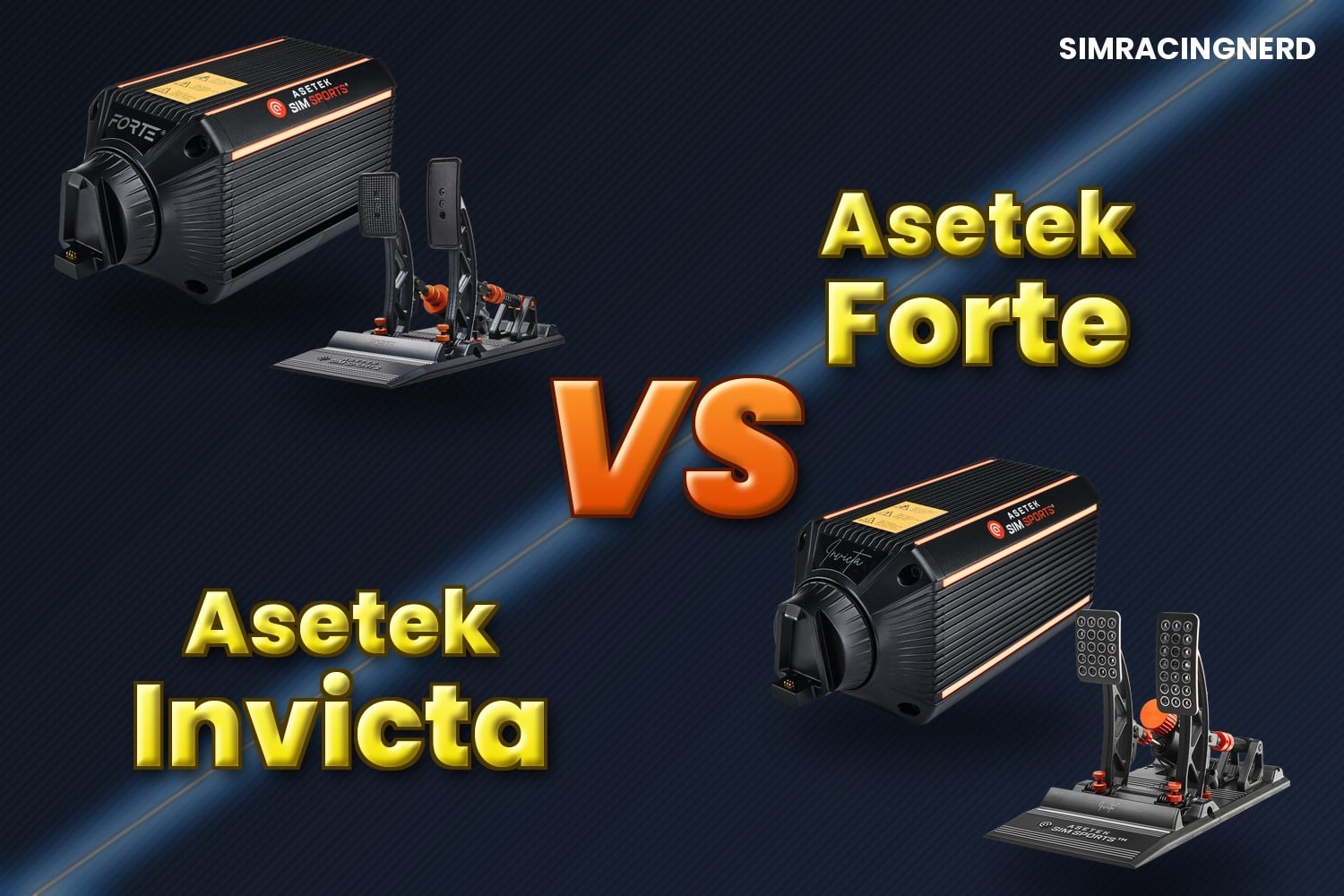

At Asetek, above the entry-level Initium and La Prima lines, the high-end segment is split between Forte—in the middle of the lineup—and Invicta, which sits at the top. At full price, a complete Invicta configuration costs just over €820 more than its Forte equivalent. As a result, as soon as a gamer wants to build a serious setup from the Danish manufacturer, they wonder if the Invicta is really worth the extra cost.
In the complete setups sold by Asetek, only two parts change, since the brand uses the same steering wheel—the Forte Formula—in both. The base torque increases from 18 to 27 Nm, and the pedal system switches from a load-cell brake to a hydraulic pressure-sensing brake, the T.H.O.R.P. II.
For most drivers, the Forte line is more than enough, and the 27 Nm Invicta base model is rarely necessary. Its hydraulic base, on the other hand, is worth a closer look, especially since Asetek allows it to be mounted on a Forte base and the current discounted bundles change the equation.
Two parts are different; the rest is the same
Both bases use the same 22-bit encoder, capable of tracking approximately 4 million positions over a full rotation, and share the quick-release mechanism, the 400-watt power supply, the five-port USB-C hub located behind the base, and the RaceHub software. As for the pedal assembly, in both cases the brake can handle up to 180 kg on the plate, and the throttle uses the same 16-bit contactless Hall sensor.
All of the brand’s steering wheels can be mounted on both bases; the Invicta Formula requires an adapter, allowing you to customize your setup by mixing and matching the two product lines. Another thing they have in common is that both product lines work exclusively on PCs running Windows and are therefore not suitable for console gamers.
27 Nm—a margin that few drivers will ever push to the limit
On paper, the Invicta clearly dominates, with 27 Nm versus 18 and a torque slew rate of 9.4 Nm/ms versus 6.7. So it has more torque and delivers it faster, but with the same encoder, it isn’t any more precise. The extra torque mainly serves to delay clipping—that point where the base reaches its maximum and begins to clip the peaks of the signal sent by the game.
At 18 Nm, this point comes on rather late, and with the same settings, I doubt most drivers would notice a difference between the two bases while behind the wheel. In fact, Asetek recommends the Forte to those who are on the fence. The extra 9 Nm really benefits drivers who prefer a very heavy steering wheel, set their gain very high on demanding cars, or want the greatest possible margin. They’ll pay a little over €1,400 for the Invicta base, compared to around €960 for the Forte.
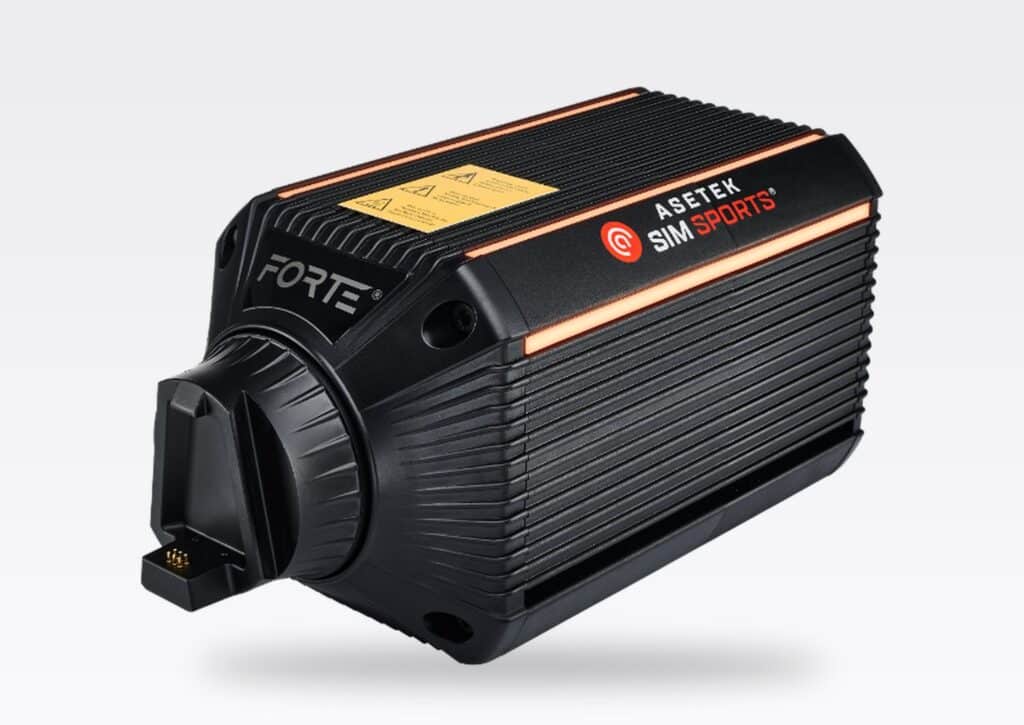
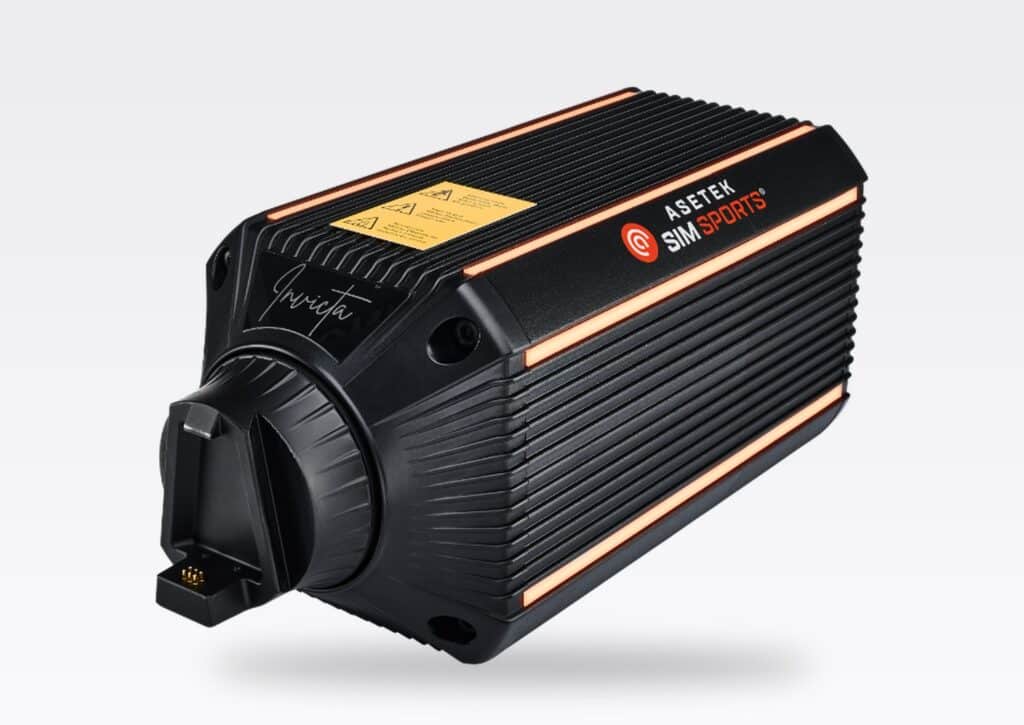
A rigid cockpit is important for both setups, but at 27 Nm, even the slightest flex takes a bigger toll, because a frame that bends absorbs some of the force feedback. The Invicta is also heavier (11.3 kg vs. 8.5 kg) and 34 mm longer, which matters if your base mount is short.
Finally, the base doesn’t get any better, unlike the brake. Asetek doesn’t offer a boost kit for the Forte, whereas the La Prima base does have one, so upgrading from 18 to 27 Nm will mean having to resell it.
The real difference comes down to the brake pedal
This, in my opinion, is where the Invicta best justifies its price. The Forte pedal set is based on a system that Asetek calls M.L.C.P.C., a force sensor located behind a small mechanical cylinder. After a short travel of 15 to 25 mm on the plate, the pedal hits a rubber stop that mimics the caliper clamped onto the disc. It is then the pressure from your foot—measured by the sensor—that modulates the braking. Asetek modeled this after the operation of a racing brake, and to me, it’s already an excellent pedal set.
On the Invicta, the T.H.O.R.P. II hydraulic cylinder controls the second phase. Once the stop is reached, your foot pushes against the fluid in the cylinder—which does not compress—and an automotive-grade sensor measures actual pressure, ranging from 0 to 100 bar. Asetek describes this stiff pedal as the closest thing to a real racing brake.
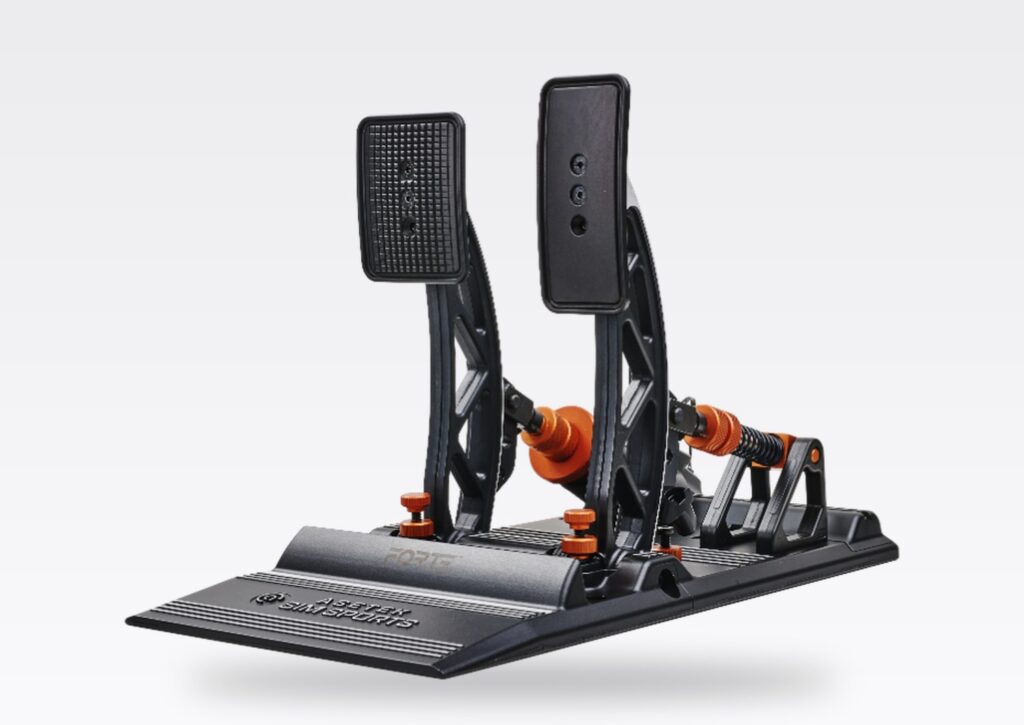
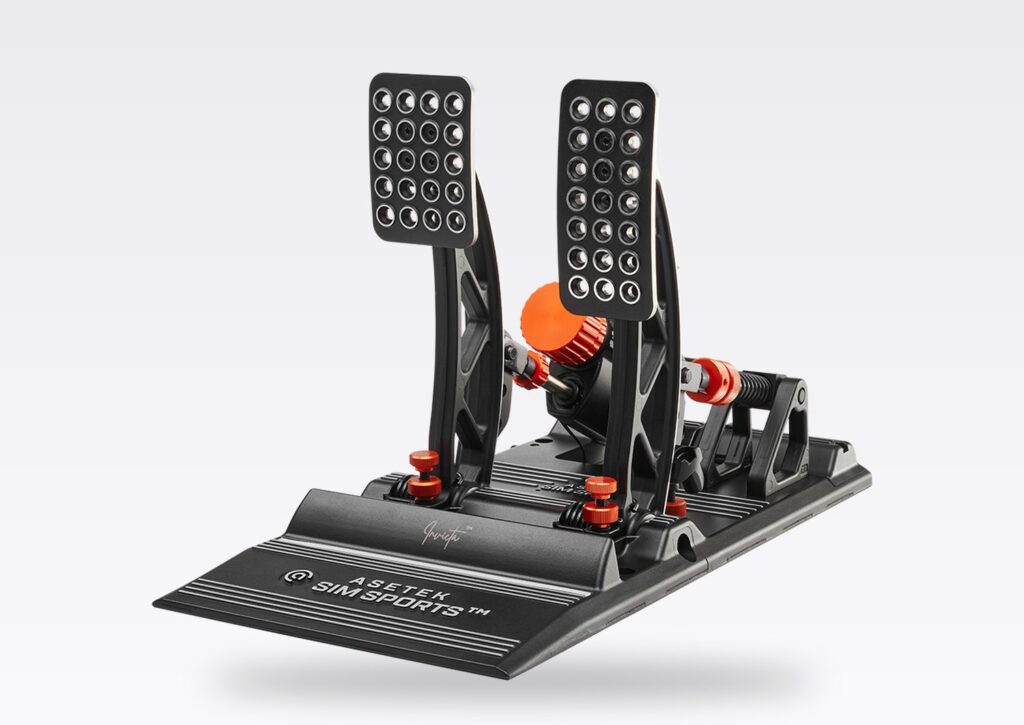
Compared to the first model, which was considered very demanding, the THORP II offers greater flexibility, with up to 40% more travel and a second phase reached with less effort. It also comes with five elastomers and a long-stroke kit, allowing you to switch from a short, stiff brake to a longer, smoother pedal. The Forte has only two elastomers, but that doesn’t make it a subpar brake by any means, and the choice between the two is ultimately a matter of personal preference.
As for the footplates, the Invicta’s—which are perforated and have studs—provide excellent grip with sim racing shoes but can be uncomfortable when worn with socks, whereas the Forte’s are designed for use without shoes. The Invicta pedal plates are adjustable for both width and height, while the Forte’s are adjustable only for height; however, Asetek sells the pedal plates for each line separately, and they are compatible with the other pedal set.
The THORP II kit makes your choice of pedal set less final
Unlike the base model, the Forte pedal set is upgradeable. Asetek sells the THORP II hydraulic cylinder separately as a kit to be mounted on the Forte pedal set for about €400, with the Invicta plates included in the box. The Forte pedal set, priced at less than €490, comes to about €885 when paired with this kit, compared to about €860 for the Invicta pedal set.
For about 30 euros more, you get the same brake cylinder and the same pads, while still having time to check whether the force sensor meets your needs. The clutch isn’t a deciding factor either, since the Invicta Clutch System, which costs around 260 €, can be added to either option.
The steering wheel doesn’t make a difference, unless you’re going for the Invicta Formula
Asetek includes the same Forte Formula—priced around €530—in both its Forte Performance bundle and its Invicta-based Pro DD27 bundle. This steering wheel covers all the essentials for single-seater racing—excluding the screen—with 12 buttons, 3 rotary controls, 6 thumbsticks, two funky switches, and two magnetic paddles.
There is, in fact, an Invicta steering wheel—the Invicta Formula—hand-assembled in Denmark, which features a carbon-fiber front face, aluminum controls, six paddles, and a configurator. It starts at around €1,330, not including the handles or the USB-C quick-release adapter required for an Asetek base, bringing the total to just over €1,550 ready for installation. However, its 4.3-inch screen is the same as that of the Forte Formula Pro, which costs about €755 with its grips, so the extra cost mainly covers the construction and the paddles.
How much the two configurations cost
At full price, the Forte Performance configuration (18 Nm base, Forte Formula flywheel, and Forte crankset) costs about €1,970, and the Pro DD27 (Invicta base, same flywheel, THORP II crankset) costs about €2,800. Of the difference of just over €820, approximately €450 is due to the base model and approximately €370 is due to the pedal set.
Both bundles are currently on sale, priced at around €1,760 for the first and around €2,470 for the second, which narrows the price difference to just over €700. If you’re interested in the hydraulic brake, the Forte Performance bundle—which includes the THORP II kit—costs less than €2,170, with the same brake cylinder as the Invicta. And if you want the Invicta base model, the discounted Pro DD27 costs only about 40 euros more than the Invicta base model, the Forte Formula and the Forte pedal set purchased separately (around €2,430 total), meaning the hydraulic brake is practically free as long as the discount lasts.
My verdict
Go with the Forte series by default. Its 18 Nm base torque offers more headroom than most drivers will ever need, and its force-sensing pedal set is already top-of-the-line. The Forte Performance bundle is the easiest way to buy it, and you can find the rest of the lineup on my page dedicated to Asetek SimSports.
Go for the Invicta base if you like a very heavy steering wheel, often drive with high gain on demanding cars, and have a cockpit that can handle 27 Nm. As long as the Pro DD27 is on sale, get it as a bundle—the hydraulic pedal set costs almost nothing extra.
If it’s the hydraulic brake that appeals to you—and in my opinion, that’s the best reason to check out the Invicta—go for the pedal set rather than the base model, with the Forte Performance bundle and the THORP II kit while the discounts last. That way, you’ll get the features that really make a difference in how the brakes feel, without paying for torque that you probably won’t use.

0 Comments