
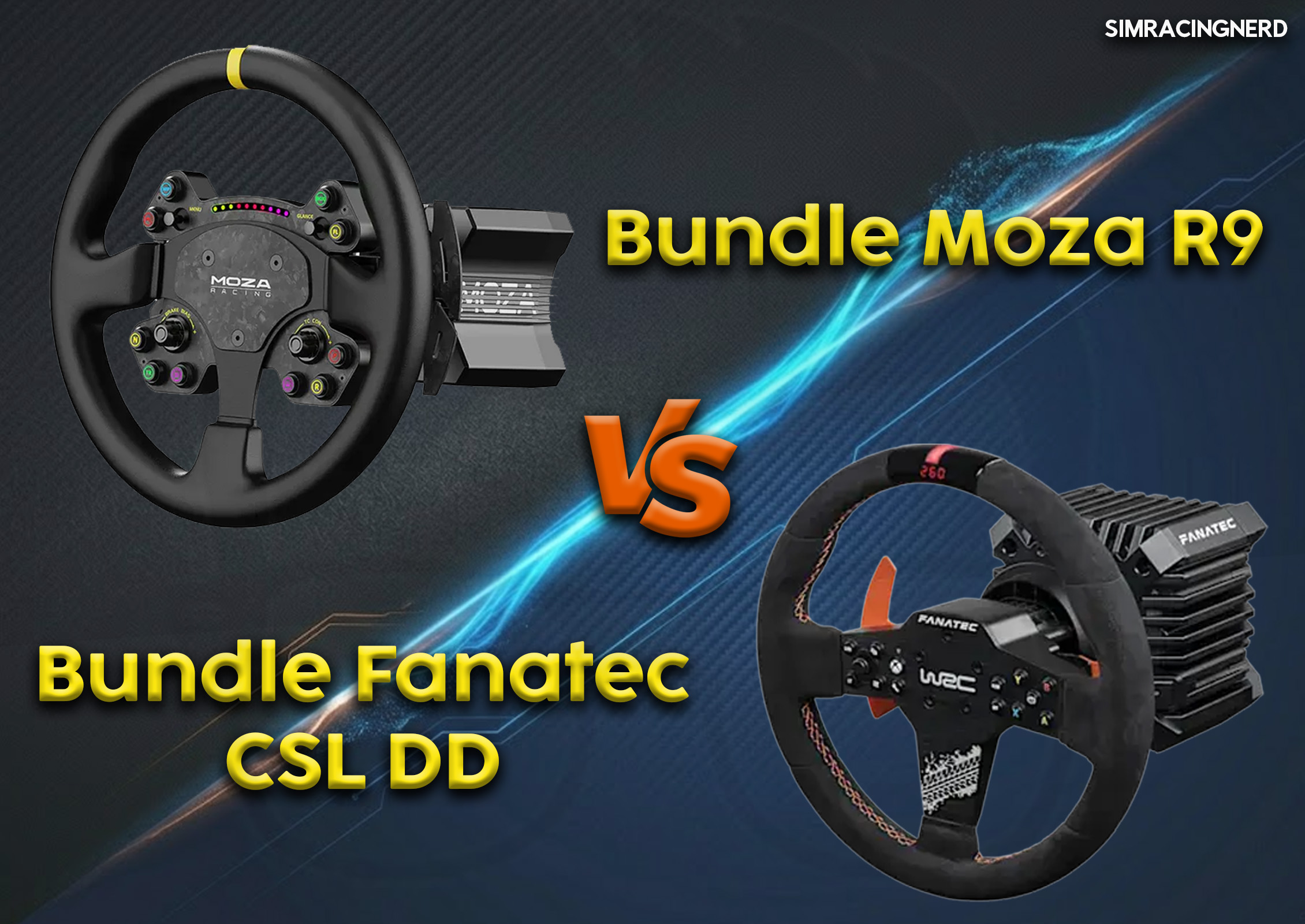

Even though Moza Racing has been in the sim-racing market for less than 10 years, its rivalry with Fanatec seems to date back much further than that. Moza is clearly targeting the German sim-racing peripheral brand across virtually every segment of the racing simulation market.
For drivers with experience in this area who are looking for a bundle that delivers less than 10 nm of torque, both manufacturers offer options in their catalogs. At Moza, the R9 fits the bill, with several steering wheels available to cater to as many motorsport disciplines as possible. At Fanatec, the CSL DD with a boost kit—delivering a maximum of 8 nm of torque—and its various steering wheel variants compete with Moza’s offering.
With two options that are very similar in terms of power, a tricky question arises: Which bundle should you choose for your setup? In the following, we’ll try to answer this question so you can make a logical, fact-based decision—and, above all, one that’s perfect for your needs.
Design and Build Quality of the Bundles
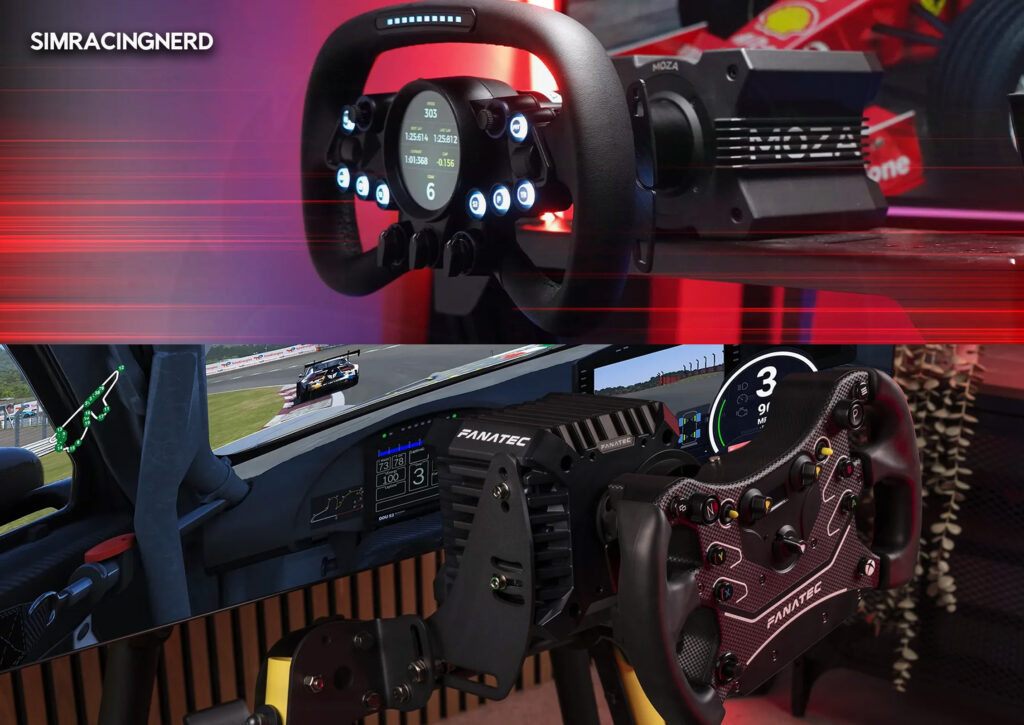
The R9 bundle is centered around Moza’s Direct Drive R9 base. It features an “X”-shaped design, a black finish, and logos scattered across the chassis. Visually, the base is attractive, with a fairly long drive shaft at the front and a few fins on the sides.
At Fanatec, the design is much more industrial, with a square shape and fins all over. This helps cool the motor and electronics, but also gives it a visually appealing look, I must say. Just like the R9, it’s black, with logos on the sides, and a very short drive shaft that consists solely of the QR2 Base Side.
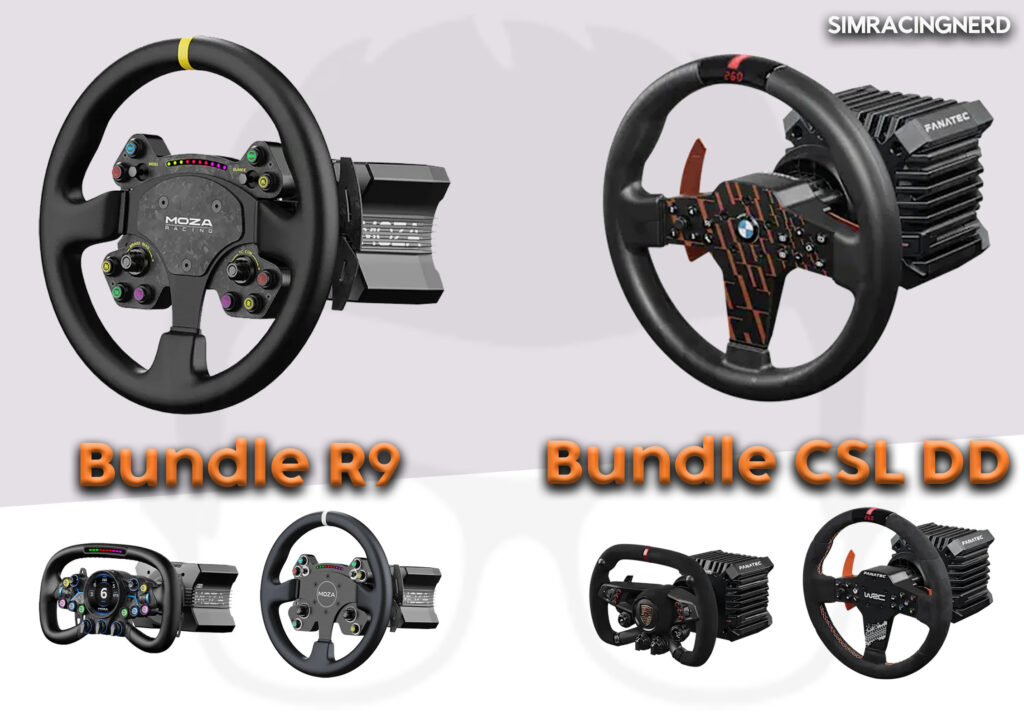
Each brand offers its own bundles with several steering wheel options, ranging from touring and GT-style wheels to Formula-style wheels.
In terms of build quality, both devices feature a metal frame with a very polished finish. I didn’t notice any defects on the CSL DD bundle, which is to be expected since Fanatec has been selling it for quite some time. But what’s most surprising is that the R9 bundle is also very well made. It’s more or less on par with Fanatec, at least compared to the CSL line.
Customized assembly
The CSL DD 8 nm is equipped with a bracket-based mounting system, allowing for installation from both the bottom and the sides. What’s more, Fanatec has added the option of front mounting using a front plate and screws. There’s also a clamp available in the brand’s store that lets you mount the base on furniture.
For steering wheels, the CSL DD 8 nm uses the QR2, which is a major improvement over the first version it replaces. The result: a much more robust connection, easier installation and removal of the steering wheel, and full compatibility with all of the brand’s steering wheels.
With the Moza and the R9, mounting is done from below using a clamp or a cockpit mounting system.
As for Moza’s steering wheels, the brand has developed—in partnership with Simagic—a Quick Release system based on the D1 Spec. The connection to the steering wheel is superior to Fanatec’s offering, and it’s clear that this product is designed for a professional audience.
Platform compatibility
Depending on the steering wheel, the CSL DD bundle is compatible with either PCs, Xboxes, or PlayStations. In theory, this is determined by the CSL DD platform itself, which is natively supported by Xboxes (provided you have the right steering wheel) and PCs. And if you want PlayStation compatibility, you’ll need to purchase the GT DD Pro, which is a variant developed in collaboration with Sony for Gran Turismo fans.
At Moza, the R9 unfortunately only works on PC. This is true for almost the entire lineup from this manufacturer, with the exception of the R3 bundle, which is available in both PC and Xbox versions.
Variety of ruffles
With over 20 years of experience, Fanatec is ahead of the competition in this regard. The brand’s lineup of steering wheels and steering sets includes more than 50 models—literally one for every virtual driver.
As part of the CSL DD 8 nm bundle, Fanatec offers Formula, GT, endurance, proto, drift, rally, and touring steering wheels. This covers everything in sim racing, but unfortunately, most of the options available are made of plastic, due to the CSL lineup.
Moza has taken a different approach: it’s much more conservative, covering the main racing categories (Formula, GT, touring), but with steering wheels that are premium compared to those included in the CSL DD bundles. I’m not saying that Fanatec’s lineup is of lower quality—no. It’s just that most of the steering wheels included in the CSL DD bundle are from the CSL line, so they’re essentially budget-friendly.
Sensation on the track
On paper, the difference in power between the base R9 and the 8-nm CSL DD is just one nm. But the specs of a Direct Drive base aren’t everything—it’s how it performs that matters in sim racing.
The CSL DD 8 nm is a boosted version of the 5 nm. As a result, the hardware remains the same—which is not the case with Moza Racing’s R5 and R9: the electric motors, as well as the electronics, are not identical. However, with Fanatec, the performance of the CSL DD 5 nm and 8 nm is virtually the same, with base settings that are precise, predictable, and, above all, granular across the entire power range.
It’s smooth—there’s nothing unpredictable about how the torque is delivered. You get the maximum power output, and the amplifier gives you everything it’s got, without going overboard or clipping. So yes, if you don’t configure the CSL DD 8 nm correctly, you’ll experience saturation at high volumes, just like with virtually all other DD amplifiers.
Let’s now move on to the R9 base. You might think there would be a big difference between how the two devices perform—especially given that Fanatec has more experience in virtual racing—but you’d be wrong. The two bases are virtually identical across their power range.
Torque is delivered in a granular manner on the R9, just as it is on the 8 nm CSL DD. It’s precise, responsive, and above all, easy to master. The only major difference between the two platforms is the time it takes to properly set up the R9, and this is where the Fanatec experience really shines.
Value for money
Moza and Fanatec offer the R9 and CSL DD bundles in different versions. Essentially, they are all the same; only the steering wheels differ, allowing the bundles to be used in various sim-racing disciplines.
Prices at Moza start at €680 for a GT steering wheel and a touring steering wheel, and go up to €1,230 for a superb steering wheel with a central display. Note that each bundle comes without a pedal set. The R9 bundles offer good value for the money overall.
At Fanatec, the CSL DD 8 nm starts at the same price—€670—but tops out at €950. Note that all CSL DD bundles come with a pedal set, making them better value for money than the R9 models.
Which one to choose?
With the 8-nm R9 and CSL DD bundles, the choice is no longer about performance or how the bases perform. It’s much more about the ecosystem you’ll be diving into, as well as the setups you can create.
At Moza, the R9 doesn’t come with a pedal set, which means you’ll have to spend at least an additional €160 on a load cell. As a result, purchasing an R9 bundle could potentially cost between €840 and nearly €1,400.
With the CSL DD 8 nm, the value is slightly better on some bundles. To be honest, all CSL DD models come with steering wheels made largely of plastic, since this is a budget-friendly line. As a result, to get a good steering wheel, you’ll need to look at other peripherals that cost at least €230. So, a CSL DD bundle with a high-quality steering wheel and an LC pedal set ranges from €1,080 to €1,260.
However, Fanatec is a much more appealing brand when it comes to its product lineup and peripherals. If you love sim-racing steering wheels and want to own several different models tailored to various motorsport disciplines, then Fanatec is the go-to choice.
Moza Racing remains an excellent alternative—and is objectively less expensive if you’re looking for a simple bundle with a nice steering wheel—but expect to spend more time properly tuning the R9 base to achieve the same feel as the CSL DD.
In short, if you’re looking for a complete ecosystem, then go with the CSL DD 8 nm. And if you just want a bundle that gets the job done—with good steering wheels and a reasonable price—in exchange for investing some time to fine-tune the settings, then go with the R9.
0 Comments